Surgical & Anesthesia Apparatus · Volume 5
Collecting, Identifying and Displaying
This is the collector’s volume. The four that precede it are about how the operating room and the anesthetist’s trolley acquired their apparatus; this one is about the apparatus after it leaves clinical life — how you tell what a bench specimen actually is, how you date it, why so much of it is mislabelled when it reaches the antique trade, and how to live with an object that was engineered a century ago for a room that no longer exists. It is written from the position this wing was founded on: that the confident label on the lot card is a claim to be tested, not a fact to be inherited.
5.1 Reading the object: maker’s marks
Nearly every serious piece of surgical or anesthesia apparatus carries its maker’s name, and for a large stretch of the trade that name is the fastest route to a date and an origin. Instruments were stamped — on the shank of a forceps, the ferrule of a scalpel handle, the frame of a mask, the base plate of a machine — and the great houses stamped consistently enough that the mark itself is datable.
The names worth knowing on sight are a small set. Codman & Shurtleff of Boston was established in 1838 by Thomas Codman, issued its first catalog in 1860, supplied surgical kits to Union Army field hospitals in the Civil War, and later became a specialist neurosurgical and orthopaedic house; it survives today as a Johnson & Johnson subsidiary. V. Mueller & Co. of Chicago dates from 1895 and grew out of that city’s tradition of handcrafted instrument work. J. Sklar Manufacturing Co. was founded in Brooklyn in 1892 and later operated out of Long Island City, New York — geographically and commercially in exactly the world that produced my Sorensen machine — and can show better than a century of continuous trading. In Britain, Down Bros. of London (St Thomas’ Street, Borough, directly opposite Guy’s Hospital) was founded in 1874 and was a major maker with a strong ear-nose-throat line, later merging into Downs Surgical. (Collectors will see 1879 given as the founding date too; that is the year the St Thomas Street business appears in the record as Millikin & Down, and it postdates the firm.) And Kny-Scheerer Co. of New York was the great American importer-manufacturer of the pre-WWI era, whose thick illustrated catalogs are themselves a dating reference — the war cut off its German supply lines and reshaped the firm.
A mark tells you more than a name. Firms changed corporate style — ”& Co.,” “Inc.,” “Ltd.,” an added city, a changed street address — on documentable dates, so the exact wording narrows the window. An address on a base plate can be cross-referenced against city directories, exactly as the Sorensen dive pins its machine’s 177 East 87th Street plate to the 1914–1915 New York telephone books. And absence is evidence too: my own Sorensen base plate carries only “NEW YORK, N.Y.” with no street — a detail that has to be reconciled against, not smoothed into, the directory record.
5.2 Dating by plating: nickel to chromium
When there is no legible mark, the object’s finish is a surprisingly good clock. Bright metal surgical and ENT apparatus was electroplated for corrosion resistance — repeated steam sterilization is brutal on bare carbon steel — and the plating chemistry changed on a known timeline.
Through the late nineteenth century and into the 1910s the standard bright finish was nickel plate: a warm, slightly yellow-grey plating that dulls to a soft haze and, on worn high spots, tends to flake or “blister” away from the steel beneath. Chromium plating is a later technology. A workable commercial process was developed by Colin Fink and Charles Eldridge at Columbia University, giving the first commercial electrodeposition of chromium in 1924 — almost simultaneously in the United States and Germany — with Fink’s patent granted in 1926 and the process energetically marketed from 1925. Decorative chromium — the thin, hard, blue-white bright finish that resists tarnish far better than nickel — only entered general use from the late 1920s onward (Oldsmobile became the first automaker to switch from nickel to chrome for bright trim in 1927), and typically as a chromium flash over a nickel underlayer rather than as a replacement for it.
For the collector this gives a genuine dating cue. A warm, hazing, flaking bright finish points to a piece made before roughly the late 1920s; a cold blue-white finish that has stayed bright points to the 1930s or later. It is a cue, not a proof — nickel plating continued alongside chromium, and a Yankauer-style mask frame from any decade can be found in either finish, since the mask’s chrome-plated wire frame is itself part of the story. Run the plating estimate against the maker’s mark, the patent numbers and the catalog record; when three independent clocks agree, the date is sound.
Running alongside both is stainless steel, adopted for instruments through the 1910s and 1920s precisely because it survived sterilization without any plating at all. A firm advertising “stainless steel and chrome plated” apparatus — as J. Sklar did — is telling you, in effect, that it is trading in the 1920s-and-after world where both technologies were current.
5.3 The misidentification myths
Nothing in this hobby is more reliably wrong than the label on an auction lot, and this wing exists because of the worked example.
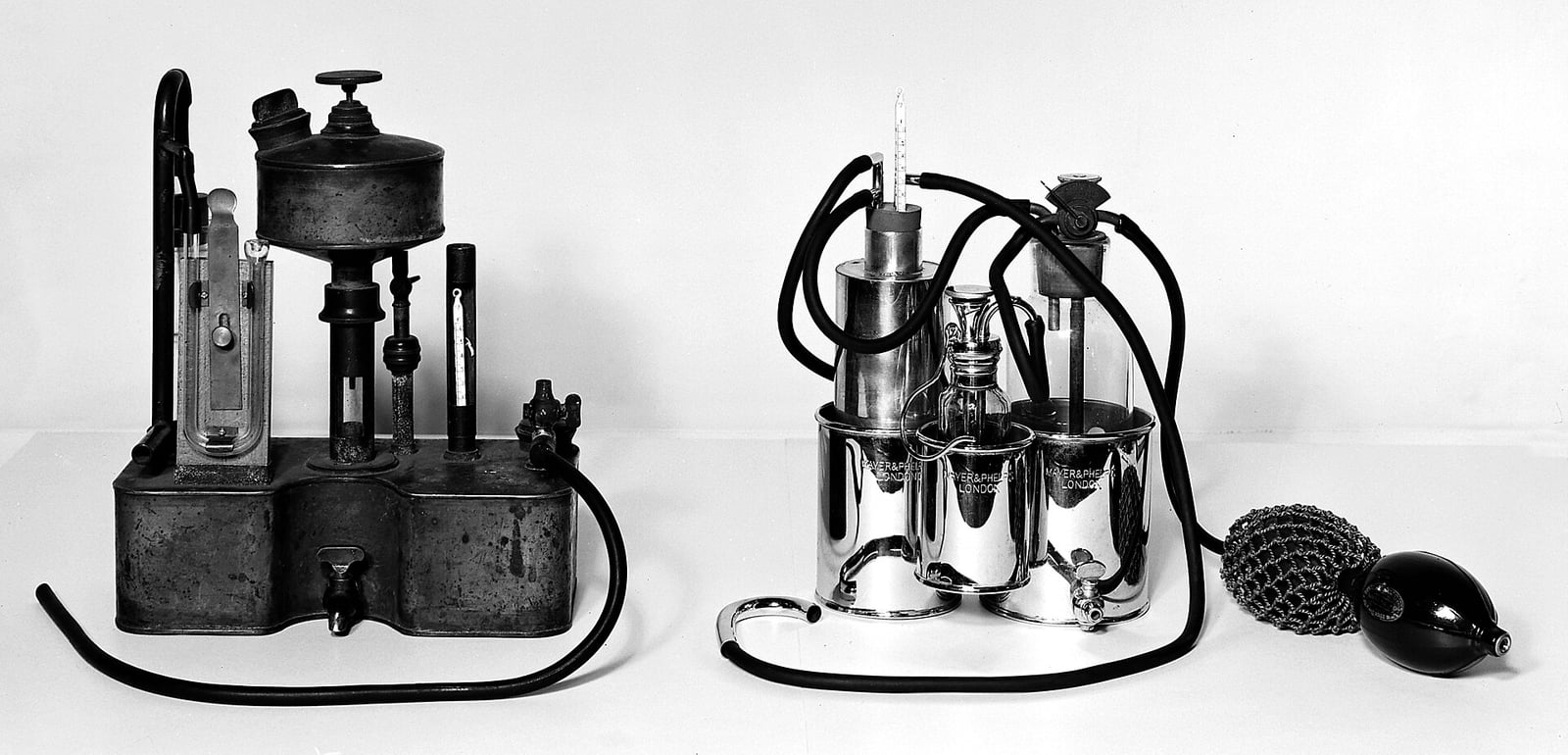
This wing’s founding machine was sold to me as a “C. M. Sorensen embalming machine.” It is not one, and the correction is not a matter of opinion. It is the No. 60, “Dr. S. Yankauer Outfit for Pressure and Suction” — an ear-nose-throat, anesthesia and minor-surgical office apparatus — and two independent primary documents settle it. Sorensen’s own 1926 Catalog of Sorensen Tankless Apparatus for the Nose and Throat Specialist and the Hospital (copyright 1925) runs forty-eight pages with not one mortuary reference in it, and its No. 60 entry specifies the diagnostic details down to the glassware: “The ether bottle is 8-oz. and square; the suction bottle 16-oz. and round. So they can not be transposed.” My machine has exactly that mismatched pair — an interlock made of glass. And a 1917–1918 advertisement in The American Year-Book of Anesthesia and Analgesia names the same “Yankauer Combination Pressure & Suction Outfit,” “especially designed for tonsil and adenoid operations,” nine years before the catalog. The full argument is in the machine’s own dive, The Machine Everybody Mislabels →.
The interesting question is why the wrong name sticks, because it is not carelessness — it is a real family resemblance. Air-pressure embalming machines genuinely existed and genuinely worked on the same principle: a motor-driven air pump pressurizing a bottle of fluid through a dip tube to force the contents out to a delivery line (see, for the architecture, US Patent 2,252,624, an embalming machine granted to Gilmore and Junod in 1941 — and not a Sorensen patent, despite occasional online claims). Twin bottles, rubber tubing, nickel plate and a mahogany base read to the market as early-twentieth-century clinical apparatus, and the funeral trade is where the market expects to file clinical apparatus that isn’t obviously a doctor’s tool. What breaks the resemblance is the numbers: a 1/20-horsepower motor at 10–15 psi and an eight-ounce ether bottle are useless for arterial injection, which needs gallons and far higher pressure. A funeral director of forty years’ standing rejected the label on exactly those grounds in 2015, before the catalog had surfaced online.
The general lesson outlasts the specific machine. An object’s identity in the antique trade is established by consensus among sellers, and that consensus is self-reinforcing and evidence-free by default. Listings cite each other, not documents; one scanned catalog overturns twenty years of confident cards. The comparison cuts both ways, which is why this wing cross-links the embalming side of the collection — the Gravity Injection Systems and Electric Embalming Machines dives — so a reader can set a real air-pressure embalming machine beside the Sorensen and see both the resemblance and the decisive difference for themselves. Auction lore mislabels medical apparatus as a matter of routine; the collector’s job is to go and find the catalog page.
5.4 Patent numbers and catalog cross-reference
Two documentary tools finish the identification. A patent number cast or stamped into a casting is a hard lower bound on the date — the object cannot predate the patent — and the U.S. patent record is fully searchable, so a number resolves to a grant year, an inventor and a drawing. Beware the trap the Sorensen dive records: a patent that matches the mechanism is not the same as a patent held by the maker; the Gilmore–Junod embalming patent describes the architecture without belonging to Sorensen at all.
Catalog cross-reference is the strongest tool of all, and the reason the great houses’ catalogs are collected in their own right. The digitized runs — Kny-Scheerer, Codman & Shurtleff, V. Mueller, Down Bros., Sklar, and specialist makers like Sorensen — sit on the Internet Archive, HathiTrust and museum digital collections, and a model or figure number in a catalog converts an anonymous bench object into a dated, named, illustrated product. That is precisely the move that settled the Sorensen: not a guess from the shape of the thing, but a page that names it.
5.5 Hazards of the objects
This section is about not being harmed by an antique — never about using one. A century-old clinical machine is a display object, and several of its materials are genuinely dangerous if disturbed.
Mercury. Old gauges, pressure switches, tilt switches, and clinical thermometers can contain elemental mercury, and it does not stay put as seals perish. A single antique thermometer holds a small charge; barometers and manometers hold far more (a mercury barometer commonly carries around four ounces). Mercury vaporizes at room temperature and the vapor is a nervous-system toxin, so a broken gauge is an inhalation hazard, not just a spill. Do not attempt to drain or “top up” mercury, never vacuum a spill (the motor heats and aerosolizes it), and route any breakage to a hazardous-waste authority.
Sharps. Surgical apparatus is full of edges and points that were designed to be sharp and were kept sharp — scalpel blades, trocars, needles, cannulae. Assume any blade is live, handle by the handle, and store points sheathed.
Residual chemistry. Old bottles, ether reservoirs and cavity-fluid vessels can hold dried or liquid residue — anesthetic agents, preservatives, disinfectants, and worse in mortuary apparatus. Treat any sealed or stoppered vessel as full until proven empty, open it only outdoors or under ventilation if at all, and never sniff to identify a contents. The Sorensen dive carries a specific caution about its own sealed bottles for the same reason.
Electricity. The machines in this wing that run on mains power — the Sorensen among them — use ungrounded universal (series-wound) motors on perished cloth-insulated wiring, built for a two-wire world with no earth and no modern insulation standard. Do not power up a century-old machine. The insulation is brittle, the frame is very likely live under fault, and there is no safety ground. Assess and display it cold; if a machine is ever to be demonstrated running, that is a bench-electrical project (isolation transformer, rewire, RCD) covered in the conservation volume — not something to try by plugging it in.
5.6 Ethics and the museum context
Surgical and anesthesia apparatus sits more comfortably in a collection than the funeral or quack wings do — it is the legitimate instrument trade, the honest engineering of care — but it still asks for the same restraint. These were working clinical objects; present them as history and as machinery, not as spectacle, and keep the register non-graphic.
The model to look to is the Wood Library-Museum of Anesthesiology (Schaumburg, Illinois), the field’s principal museum and library, whose online collection is a working reference for anyone dating anesthesia apparatus — its holdings include the Yankauer masks, the drop bottles, the inhalers and the gas machines this wing describes, each documented with the care a private collector should imitate. For surgical instruments more broadly, the Science Museum Group (which holds the Down Bros. archive), the Smithsonian’s National Museum of American History, the National Library of Medicine, and specialist medical-history collections carry the catalogs, the marks and the provenance chains that turn a bench object into a documented one.
Collect with care means, in practice: buy the object and buy its paper; record provenance rather than inventing an origin story; correct a mislabel in public where you can, because the next buyer inherits the label you leave; and remember that the most valuable thing a private collection can add to this field is not the object but the identification — the scanned catalog page that turns an “embalming machine” back into a Yankauer outfit, and keeps it that way.
Sources
- Yankauer Masks — Wood Library-Museum of Anesthesiology — Sidney Yankauer (1872–1932), the wire-mesh open-drop ether mask (~1904), chrome-plated wire frame; the field’s principal museum.
- History of Anesthesia — Wood Library-Museum of Anesthesiology — museum context and collection scope.
- Wood Library-Museum of Anesthesiology — Wikipedia — institutional overview (Schaumburg, Illinois).
- Codman & Shurtleff — medicalantiques.com and Catalogue of surgical instruments, Codman & Shurtleff — National Library of Medicine — founded 1838, Boston; first catalogue 1860; Civil War field kits.
- V. Mueller & Co., Chicago, makers of surgical instruments (1908) — WorldCat — Chicago house, established 1895.
- Stainless steel and chrome plated surgical instruments… J. Sklar Manufacturing Co — Smithsonian — Long Island City maker of “suction, pressure and anesthesia apparatus”; the nickel/chrome/stainless finish language.
- Illustrations of surgical instruments… Kny-Scheerer Co — Internet Archive and HathiTrust record — the great New York importer-manufacturer’s catalogue as a dating reference.
- Down Bros. catalogue of surgical instruments — Internet Archive and Down Bros. — Science Museum Group Collection — London ENT/surgical maker, St Thomas’ Street; later Downs Surgical.
- A Retrospective View of Nickel Plating — Products Finishing and History of Chromium Plating — Products Finishing — nickel as the earlier bright finish; Fink and Eldridge’s process and the first commercial chromium electrodeposition in 1924, the 1926 patent, and decorative chrome-over-nickel from the late 1920s (Oldsmobile, 1927).
- Marvellous Medical Materials: Stainless Steel — Institute of Making — nickel/chrome plating of steel instruments against sterilization corrosion; stainless-steel adoption 1910s–1920s.
- Mercury Legacy Products / Antiques — NEWMOA and Can an antique mercury barometer be hazardous? — Charles Edwin Inc. — mercury in antique gauges/thermometers/barometers (~4 oz in a barometer); do not drain, do not vacuum a spill.
- The Machine Everybody Mislabels — C. M. Sorensen Pressure and Suction dive — the wing’s founding correction; the 1926 Sorensen catalog and 1917 advertisement that settle the No. 60 Yankauer outfit identification.
- 1926 Catalog of Sorensen Tankless Apparatus — Internet Archive — the primary document; the No. 60 “square ether bottle / round suction bottle… can not be transposed” entry.
- US 2,252,624 — “Embalming machine,” Gilmore & Junod, 1941 — Google Patents — a genuine air-pressure embalming machine, cited for the architectural resemblance that fuels the misattribution; not a Sorensen patent.
Comments (0)