Surgical & Anesthesia Apparatus · Volume 4
Sterilizers, Sundries and the Makers
The operating room that took shape between the 1880s and the 1920s was not built by surgeons alone. Behind every aseptic theatre and every specialist’s consulting room stood a trade — a network of instrument houses, catalog printers, platers, cabinetmakers and sterilizer builders who translated the new doctrines of antisepsis and asepsis into hardware a hospital could buy. This volume is about that trade: the sterilizer and the instrument cabinet as manufactured objects, and the great surgical-instrument houses whose illustrated catalogs organized the whole market. It is business and engineering history, told through the things that survive on collectors’ shelves.
4.1 The Sterilizer Becomes a Machine
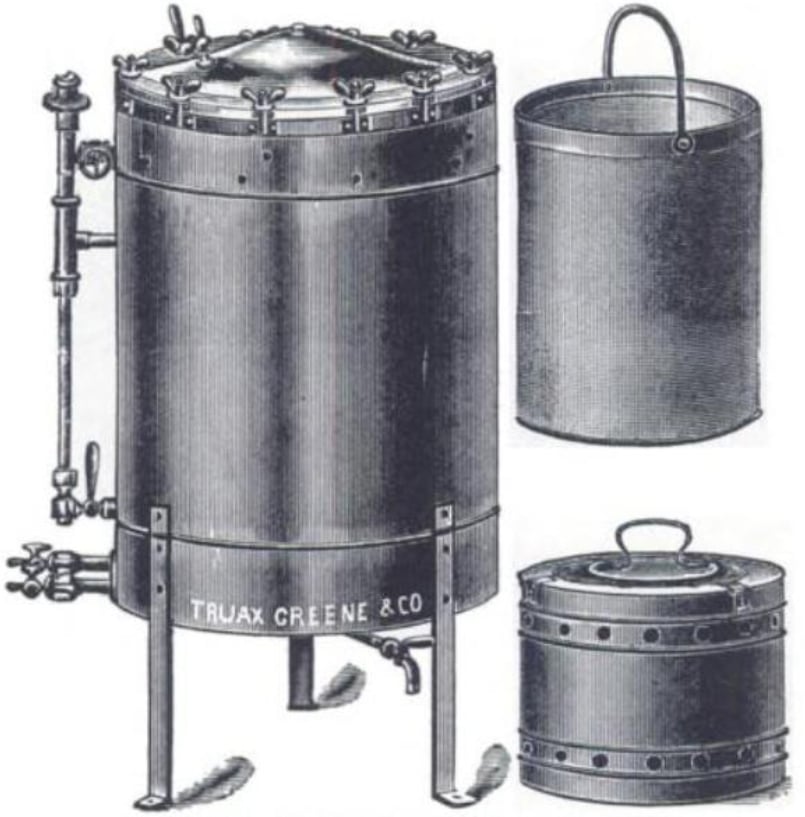
Antisepsis — Joseph Lister’s carbolic-acid method of the 1860s — killed germs chemically, at the wound. Asepsis, the doctrine that displaced it by the 1890s, tried instead to keep germs away entirely: everything that touched the operative field was to be sterile before it arrived. That shift turned heat sterilization from a laboratory nicety into a fixture of every operating suite, and it created a manufacturing category that had not existed a generation earlier.
The key device came out of bacteriology, not surgery. In 1879 Charles Chamberland, a French microbiologist working in Louis Pasteur’s laboratory, built the autoclave — a sealed chamber that raised steam above atmospheric pressure so it could reach temperatures well beyond the 100 °C of boiling water. Pasteur and Chamberland had found that killing the toughest bacterial spores required holding roughly 115–120 °C for a sustained period, which only pressurized steam could deliver. The principle was old: Denis Papin’s “steam digester” of 1679 was a pressure cooker in all but name. What was new was the application to medicine and the demand behind it.
By 1889 the surgeon Curt Schimmelbusch had adapted the idea into a drum-type instrument sterilizer for the operating room, and his name attached to both a sterilizing drum and the wire mask frame used for dropping ether. The distinction that mattered on the ground was between boiling and steam under pressure. Many hospitals through the early twentieth century still used open or lidded boiling sterilizers — long nickel-plated troughs with a perforated instrument tray and a gas or electric heater beneath — because metal instruments could simply be boiled, and boiling water plus a little washing soda was cheap and reliable. Dressings, gowns and anything that trapped air, however, needed pressure steam to be penetrated throughout, and for those the pressurized autoclave was essential. A well-appointed theatre therefore owned several sterilizers of different kinds: an instrument boiler, a water sterilizer that produced sterile water on tap, a dressing autoclave, and often a small utensil or basin sterilizer. Firms sold them as coordinated banks of matching nickel or, later, stainless equipment built into the theatre wall.
4.2 Glass, Nickel and the Aseptic Cabinet
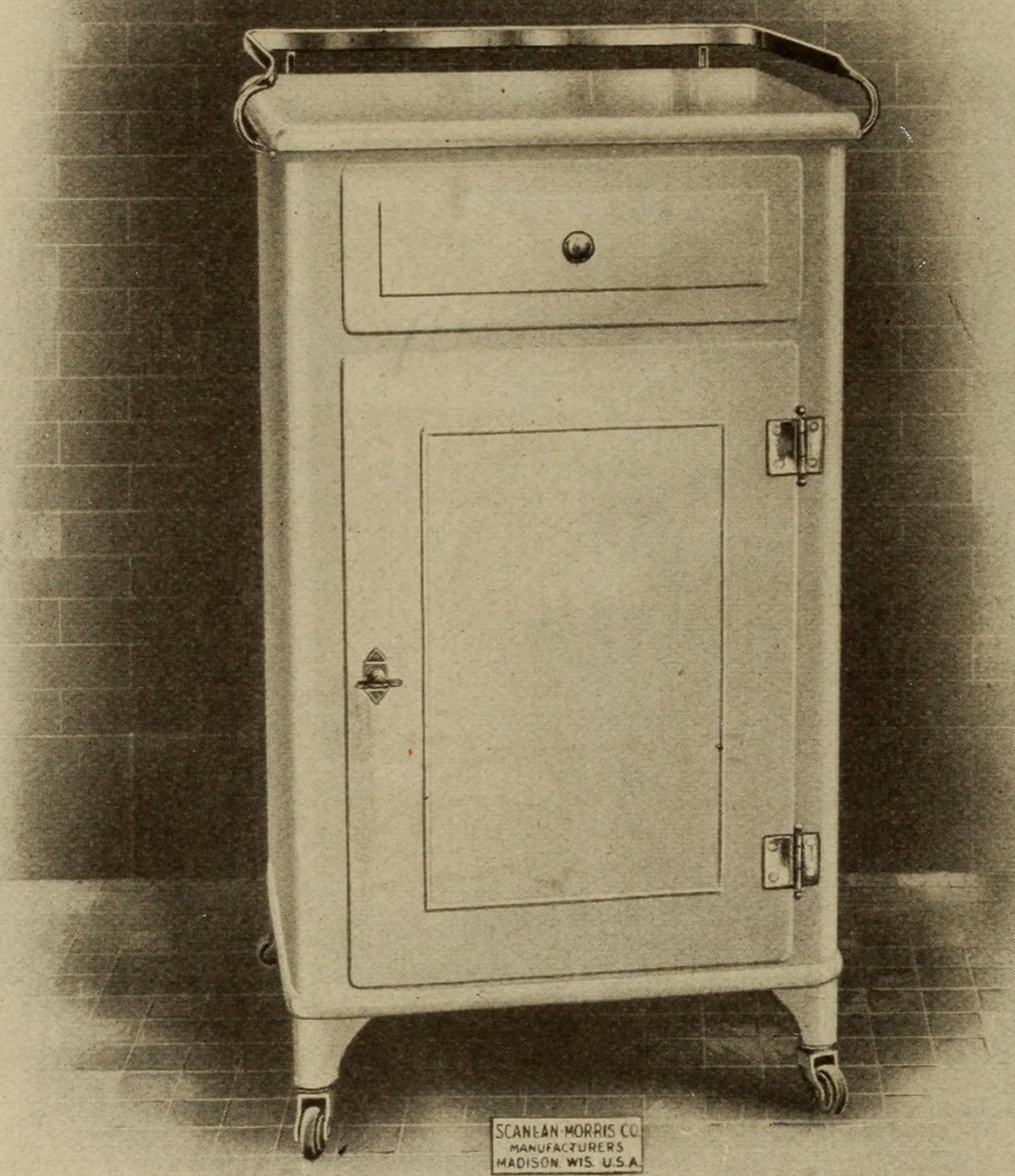
The same logic that demanded steam remade the furniture. An aseptic room had to be cleanable: no upholstery, no carved wood, no crevice that could harbor dust. The answer was an aesthetic of glass, nickel-plated steel and white enamel that defines the period at a glance. Instruments lived in glass-and-nickel cabinets — cases with plate-glass shelves, glass doors and slender nickeled frames, so that every surface could be wiped and every instrument seen. Work surfaces were plate glass, marble or vitreous enamel. Basin stands, dressing carriages, Mayo stands and the tall specialist’s cabinet all shared the vocabulary.
Nickel plating was the era’s signature finish because it resisted the rust that boiling and steam would otherwise raise on plain steel, and it took a bright, easily cleaned surface. It also dates objects: bright nickel dominates from the 1890s into the 1930s, after which chromium plating — harder, bluer, less prone to yellowing — and then solid stainless steel took over. The arrival of practical stainless surgical steel between the world wars was a genuine turning point for the trade. It let instruments be made in one non-corroding material rather than a carbon-steel core under a plating that could chip and undermine, and by mid-century “stainless” had become a selling point printed across catalog covers. A cabinet full of bright-nickel instruments and a cabinet of matte stainless are, roughly, two different decades.
4.3 The Great Instrument Houses
Around this hardware grew a set of firms whose names are stamped into the instruments themselves. They fall into a few national clusters, and their founding dates run back well before the aseptic era — most began as cutlers, makers of fine knives, and migrated into surgical work as the market matured.
In Britain, the trade was among the oldest. John Weiss & Son takes its founding to 1787 and to John Weiss (1773–1843), a cutler from Rostock — the son and great-grandson of cutlers — who set up at 42 Strand, moved to 62 Strand by 1836, and rose under William IV to the royal appointment of razor-maker to the King. (The 1787 date is the one the firm always quoted, and it sits oddly beside Weiss’s own birth in 1773; it is best read as the date of the business he came into rather than one he could have founded at fourteen.) The firm supplied the British Army, became a limited company in 1899, and traded until 1 January 2022 — well over two centuries. Down Brothers was founded in 1874 and is recorded on St Thomas’s Street in the Borough, directly opposite Guy’s Hospital — from 1879 as Millikin & Down, and as Down Bros. at 5–7 St Thomas Street by 1894. It was a deliberately chosen address, since proximity to a teaching hospital put a maker at the elbow of the surgeons who designed instruments. Down Bros. incorporated as a limited company in 1902, published some of the most comprehensive illustrated catalogs of the period, amalgamated with Mayer & Phelps in the late 1940s, and eventually became Downs Surgical before passing to Sims in 1989.
In France, the pivotal figure was Joseph-Frédéric-Benoît Charrière (1803–1876), a Swiss-born Parisian who arrived in the city as a boy, apprenticed as a cutler, and founded his own house in 1821, at eighteen, on qualifying as a master cutler. He turned instrument-making from a craft into a precision industry — some 400 workers by around 1840 — producing knives, catheters, sounds, syringes, pumps and inhalers, and he gave surgery the “French gauge” still used to size catheters today (each unit one-third of a millimeter of diameter, so a 9 Fr catheter measures about 3 mm across). His succession failed him: his son Jean-Jules, who had run the firm since 1852, died in the Paris cholera epidemic of 1865, and in 1866 the Maison Charrière was sold at auction to two of his own employees, Robert and Collin — Charrière himself living on until 1876. “Charrière à Paris,” later Collin, remained a benchmark European mark.
In Germany, the instrument industry concentrated in the small town of Tuttlingen, still a world center. There Gottfried Jetter (1838–1903) opened a workshop in 1867 and prospered by making instruments in series — mass production — while rivals still filed them one at a time; by 1878 he employed 120 people. When his brothers-in-law the Scheerers joined in 1887 the firm became Jetter & Scheerer, and in 1889 it registered the Aesculap trademark device — the staff-and-serpent of Asclepius under a crown — with the brand name itself following in 1899. Aesculap opened branches in New York, London, Paris, Constantinople, Buenos Aires and Tokyo from 1893 onward and grew into the largest surgical-instrument maker in the world; B. Braun took a controlling interest in 1976, and the Aesculap name endures.
In the United States, the houses were younger but the market larger. Codman & Shurtleff of Boston is generally dated to 1838, founded by Thomas Codman to make surgical instruments; it supplied field-hospital kits during the Civil War, issued its first catalog around 1860, later specialized in neurosurgical and orthopedic instruments, and became a Johnson & Johnson subsidiary. V. Mueller of Chicago was built by Vinzenz Mueller, who brought German instrument craftsmanship to the United States in 1893 and established his own storefront in 1895; it grew into one of the country’s dominant instrument lines, later collaborating with surgeons whose names became instrument eponyms — Metzenbaum, Cushing, DeBakey. J. Sklar Manufacturing was founded in 1892 in Brooklyn, New York — at 133 Floyd Street, later moving across the East River to Long Island City — and grew into a very large catalog house; notably, one of its Smithsonian-held catalogs is titled Stainless Steel and Chrome Plated Surgical Instruments: Suction, Pressure and Anesthesia Apparatus — the very category of office machine this wing is built around. Kny-Scheerer of New York — organized in 1896 around Richard Kny to give the German trade a firmer American footing — was among the oldest and largest US dealers in surgical and hospital supplies, offering everything from sterilizers and atomizers to X-ray and electrotherapy apparatus; it passed under the Vadsco Sales holding company in 1928.
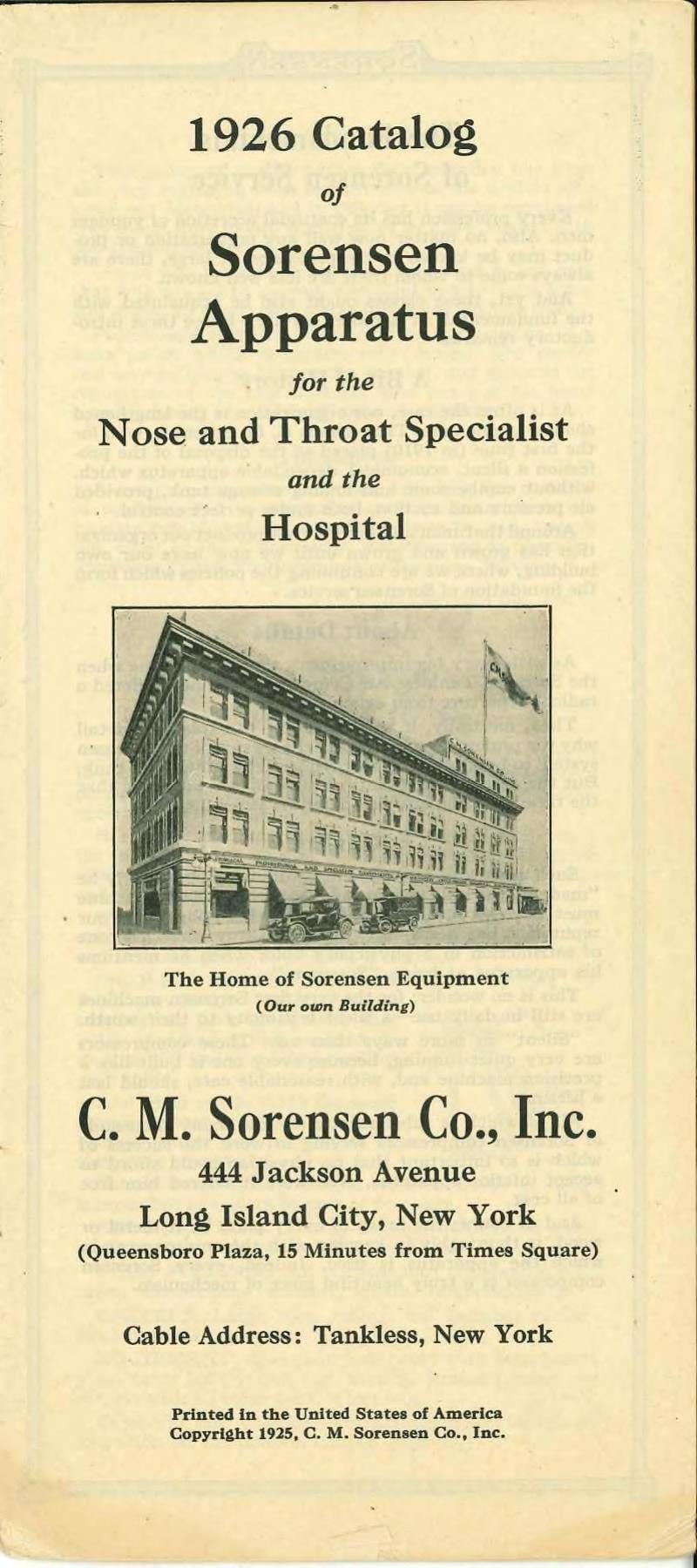
Alongside these were the specialist-office suppliers — makers who did not build the whole hospital but outfitted the individual practitioner’s consulting room with the small powered apparatus the era demanded. The C. M. Sorensen Co. of New York is exactly such a house: its “Tankless” pressure-and-suction outfits were sold to the ear-nose-throat and minor-surgery specialist rather than to the operating theatre, and its catalog sat in the same office alongside the instrument cabinets and sterilizers described here. Its story is told in this wing’s founding dive: the C. M. Sorensen Pressure and Suction Apparatus.
4.4 The Catalog Organized the Trade
The illustrated trade catalog was the central document of this industry, and to a collector it is often the only way to identify or date a surviving object. Between roughly 1750 and 1914 the medical catalog evolved from a plain price list into a heavy, wood-engraved and then half-tone volume that functioned simultaneously as advertisement, reference work and de facto standard. A large house’s general catalog might run to a thousand pages, organized by surgical specialty — general, gynecological, ophthalmic, ear-nose-throat, urological — with each instrument numbered, illustrated and priced, and frequently named for the surgeon who had designed or popularized it.
That structure did real work. It standardized nomenclature across a fragmented craft: when a surgeon ordered “a No. 5 Mayo scissors” or “an 8-oz square ether bottle,” the catalog number made the request unambiguous on both sides of the transaction. It also embedded the eponym system that still governs surgical vocabulary — Metzenbaum, Kelly, Halsted, Yankauer — turning a designer’s name into a permanent product line. And it let a specialist assemble a practice by mail: an ENT surgeon could outfit an entire consulting room — cabinet, sterilizer, atomizers, a Sorensen pressure-and-suction outfit, a set of laryngeal instruments — from a single supplier’s book, delivered as a coordinated ensemble in matching nickel.
4.5 Marks, and How to Read Them
The instruments carried their identity in a stamped maker’s mark, usually on the shank or ring, and these marks are the collector’s primary evidence. A mark may give the firm’s name and city, a trademark device (Aesculap’s crowned serpent-staff; a royal coat of arms on Weiss horn handles), a pattern or catalog number, a material stamp such as “STAINLESS” or a steel grade, and sometimes a retailer’s name rather than the actual maker’s — because large houses both manufactured and imported, reselling German and French instruments under their own name. That last point is a standing trap: a “Kny-Scheerer” or “Codman & Shurtleff” stamp does not prove Boston or New York manufacture, since much of the American trade in the nineteenth century was imported Tuttlingen and Paris work re-marked for the domestic market. Reading a mark therefore means reading the whole object — the mark, the plating, the pattern, and the catalog it can be matched to — rather than trusting the name alone.
The same discipline recovers the story of a mislabeled machine. This wing exists because an object sold as an “embalming machine” turned out, on the evidence of the maker’s own 1926 catalog, to be a specialist’s pressure-and-suction office outfit — a reminder that in this trade the catalog, not the auction listing, is the authority. Identification, dating and the myths that cling to these objects are the subject of the volume that follows.
Sources
- Codman & Shurtleff, Inc. — Makers of Surgeons Instruments (Huntington Library record)
- Catalogue of surgical instruments, Codman & Shurtleff — National Library of Medicine Digital Collections
- V. Mueller & Co., Chicago — General catalogue (Internet Archive)
- V Mueller — company history
- Down Bros Ltd. (1874–1989) — RCPSG Heritage
- Down Brothers — Science Museum Group Collection
- The Rise of the Medical Trade Catalog in Britain, 1750–1914 (Claire Jones, White Rose)
- John Weiss & Son — Wikipedia
- John Weiss & Son, Ltd. (1787–) — RCPSG Heritage
- Joseph-Frédéric-Benoît Charrière — Wikipedia
- Charrière / Collin, famous French surgical instrument manufacturer — Museum of Medicine
- French catheter scale — Wikipedia — one French unit = 1/3 mm of diameter, not circumference
- Aesculap (former Jetter & Scheerer), Tuttlingen — Museum of Medicine
- Aesculap Division, B. Braun Group (1867) — Science Museum Group
- Kny-Scheerer Company — College of Physicians of Philadelphia
- Illustrations of Surgical Instruments … Kny-Scheerer Co. (Internet Archive)
- J. Sklar Mfg. Co. — Stainless Steel and Chrome Plated Surgical Instruments: Suction, Pressure and Anesthesia Apparatus (Smithsonian)
- Sklar Corporation — About Us
- The History of Sterilization of Medical Instruments (MC College)
- Who Invented the Autoclave and Its Historical Impact (Tuttnauer)
- Autoclave — Wikipedia
- A Directory of Reference Sources: Antique Medical and Surgical Instruments — New York Medical College
Comments (0)