Surgical & Anesthesia Apparatus · Volume 3
Pressure and Suction
This wing of the collection has, so far, exactly one subject and one machine at its centre: a small mahogany-based air pump made by the C. M. Sorensen Company of New York, sold to me — wrongly — as an embalming machine. The full argument for what it actually is lives in the machine’s own dive, C. M. Sorensen “Tankless” Pressure and Suction. This volume steps back from the single object to the idea behind it: why, in the ear-nose-throat and minor-surgery office of the early twentieth century, one small electric motor came to do two apparently opposite jobs — blowing air out and drawing air in — and why that pairing turned out to be one of the more durable ideas in the history of surgical apparatus. One half of it is still in use in every operating room and ambulance on earth.
3.1 Two jobs for one motor
Blow and suck are the same machine’s two ends. A reciprocating air pump has a low-pressure inlet and a high-pressure outlet; a piston that draws a vacuum on one stroke discharges compressed air on the next. The realization that the office had steady uses for both ends of that pump, at the same time, is the engineering idea this whole subject is built on.
On the pressure side, moving air had a family of jobs that the specialist did every day. Compressed air atomized a liquid drug into a fine mist — a spray or nebulizer — to be carried into the nose, throat, or bronchi. It could blow a medicated powder onto an inflamed membrane. And, most consequentially, a stream of air bubbled through or passed over a volatile anesthetic liquid picked up that agent’s vapor and carried it to a face mask, mouth gag, or ether hook for administration during a short operation. (Following the register of this collection, the anesthetic agents here — ether, chloroform — are treated strictly as chemistry and trade history; nothing in this volume is a dosing or technique instruction.)
On the suction side, the same motor drew a partial vacuum to clear the operative field. In tonsil, adenoid, and sinus work the surgeon’s problem is not the cut but the view: blood and secretions fill a small, deep, awkward cavity faster than a sponge can clear it. A steady vacuum drawing fluid away through a rigid tube into a collecting bottle kept the field visible. The same vacuum ran aspirators, did “vacuum massage,” and drew fluid in sinus procedures.
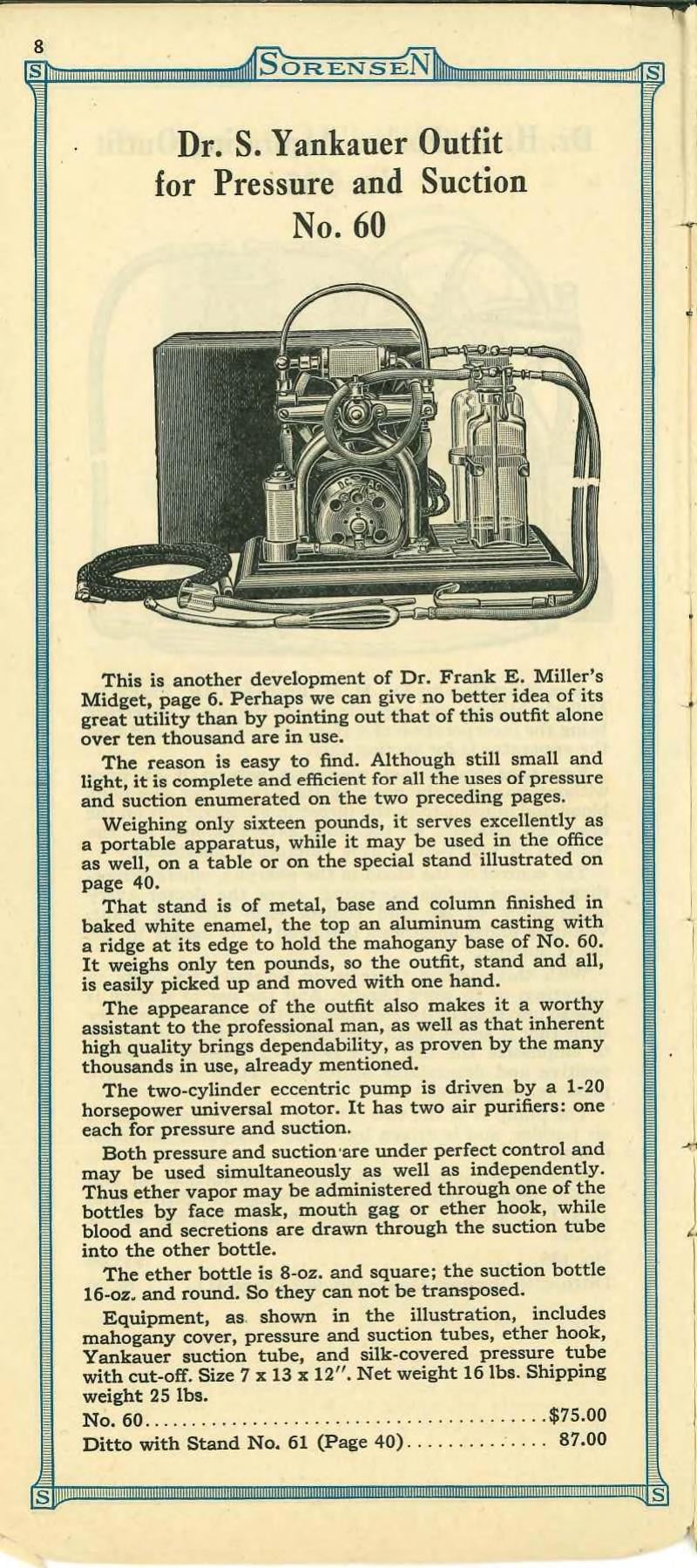
Put those two lists beside each other and the combined outfit designs itself. A single fractional-horsepower motor, a single pump, and a valving arrangement that presents the pressure port to one bottle and the suction port to another gives the office everything on both lists from one plugged-in box. Sorensen’s own catalog advertised precisely this range of duties for the outfit — spraying, nebulizing, powder-blowing, etherizing, aspirating blood and mucus from the operative field — and made a virtue of the fact that “both pressure and suction … may be used simultaneously as well as independently.” One operator could etherize through one bottle and clear the field through the other, from the same running motor.
3.2 The engineering of the combined outfit
The generic combined outfit — of which the Sorensen “Tankless” No. 60 is the exemplar this wing is built around — resolves into a handful of deliberate design decisions, and each one is worth naming because each solves a real problem.
The pump moves air, not the working fluid. This is the quiet cleverness of the whole class of machine, and it is what most often confuses a modern viewer. The pump never touches the ether, the drug, the blood, or the mucus. It moves only air; the air then acts on the liquids indirectly, inside sealed glass bottles. On the pressure side, air pushed into a closed bottle forces liquid up a dip tube and out to the spray or the mask. On the suction side, air drawn out of a closed bottle lowers the pressure inside it, so atmospheric pressure drives fluid from the patient, up the suction tube, and into the bottle as a trap. Nothing corrosive, volatile, or biological ever passes through the pump. That is why these machines survive a century in collectable condition: the pump only ever handled clean air.
Two air purifiers, one per circuit. Because the machine breathes, it needs filters, and the combined outfit carries two — the nickel-plated “air purifier” canisters with woven mesh elements that are so visible on a surviving specimen. One conditions the air going to the pressure bottle; the other guards the pump’s inlet on the suction side, so that whatever aerosol escapes the trap bottle does not reach the cylinders. Counting these canisters is, incidentally, how you tell a two-cylinder outfit from the larger four-cylinder model, which carries four.
A twin-cylinder pump, belt-driven from a small universal motor. The pressure and suction functions are, mechanically, just the discharge and intake of a two-cylinder reciprocating (“eccentric”) pump. Sorensen’s No. 60 used a 1/20-horsepower universal motor — a series-wound motor that would run on either alternating or direct current, a genuine selling point in an era when much of American mains supply was still DC. A belt and a stepped pulley reduced the motor’s speed to the flywheel, and the flywheel turned the crank. The result was a modest, steady output — on the order of 10 to 15 pounds of constant pressure for this pump family — which is exactly enough to atomize a drug or carry ether vapor, and nowhere near enough to do the arterial-injection job the auction myth imagines (more on that below).
Bottles that cannot be swapped. The single most elegant detail of the combined outfit is a safety interlock made entirely of glassware. In the Sorensen No. 60 the ether bottle is 8 ounces and square; the suction bottle is 16 ounces and round — different sizes and different shapes — and the catalog states the reason plainly: “so they can not be transposed.” A hurried operator physically cannot seat the ether bottle in the suction station or vice versa; the mouths and cradles do not match. It is a poka-yoke — a mistake-proofing design — decades before the term existed, and it is the feature that most cleanly diagnoses one of these machines when it turns up mislabelled at auction.
3.3 Sidney Yankauer, and the tip that outlived the machine
The Sorensen combination outfit was sold, in its own advertising, as “The Yankauer Combination Pressure & Suction Outfit,” and the ether bottle fed a “Yankauer suction tube.” The name belongs to Dr. Sidney Yankauer (1872–1932), a New York otolaryngologist whose work sits behind both halves of this subject.
Yankauer was born in New York City on 27 March 1872, took his undergraduate degree at the City College of New York, and earned his M.D. from Columbia University’s College of Physicians and Surgeons in 1893. He spent his whole career at Mount Sinai Hospital, where he began in the outpatient surgical department and rose, in 1917, to become the first director of the hospital’s newly independent laryngology service. Along the way he performed what is recorded as New York City’s first successful bronchoscopic removal of a foreign body, in 1905. He died at Mount Sinai on 27 August 1932, of heart disease. A recent appreciation in the Ear, Nose & Throat Journal is titled simply “Sidney Yankauer, the Mechanical Genius” — a fair label for a working clinician who kept designing the instruments his specialty needed.
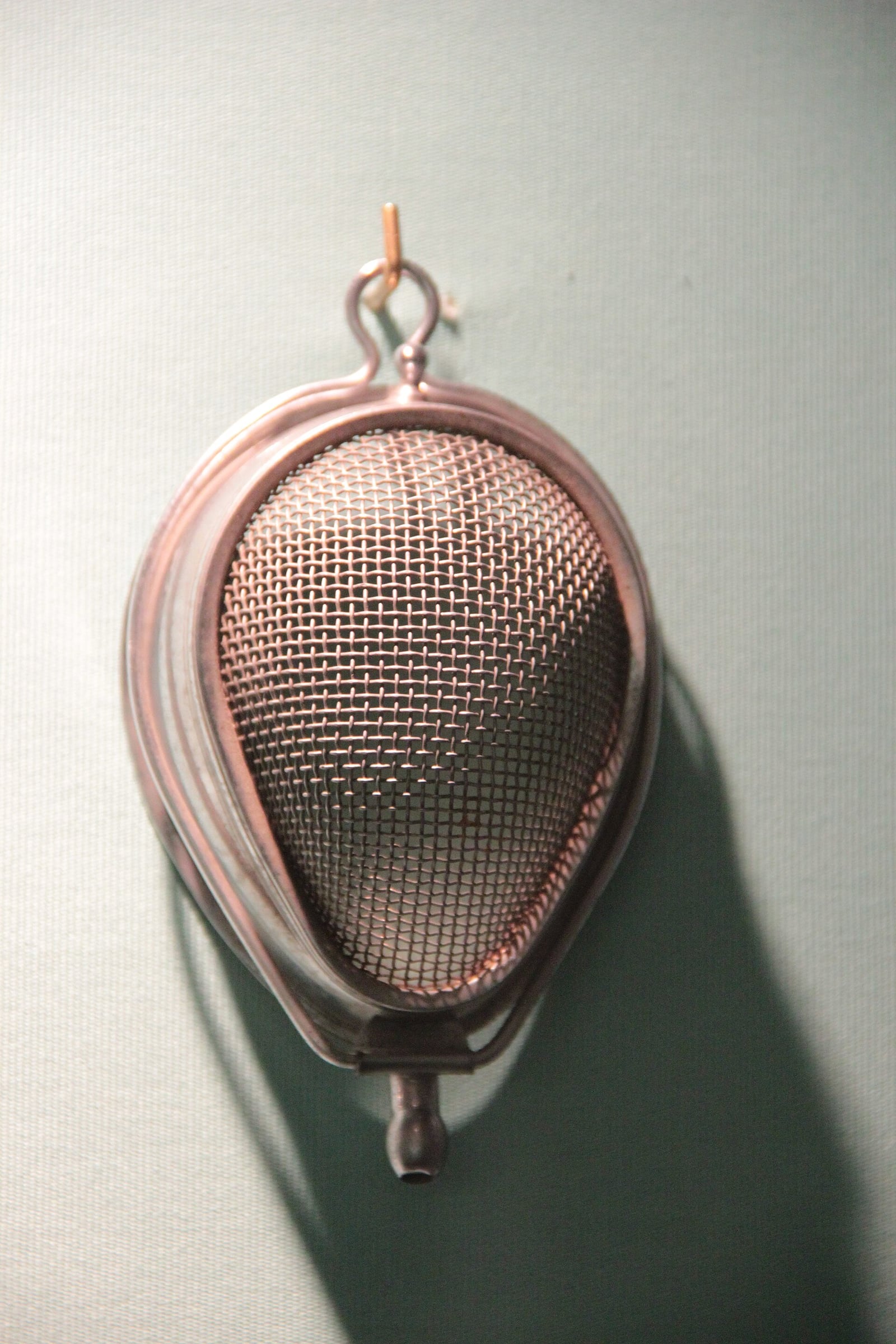
Two of those designs matter here. The first is the Yankauer mask (about 1904): a wire-mesh frame that held a folded gauze pad over the nose and mouth, with a gutter to catch excess liquid, onto which a volatile anesthetic was dripped. Originally built for chloroform, it was later modified by the anesthetist James Tayloe Gwathmey to admit oxygen, becoming the Yankauer-Gwathmey mask. It is the “face mask” the Sorensen outfit’s ether circuit was built to feed. Several survive in the collection of the Wood Library-Museum of Anesthesiology, the field’s principal museum.
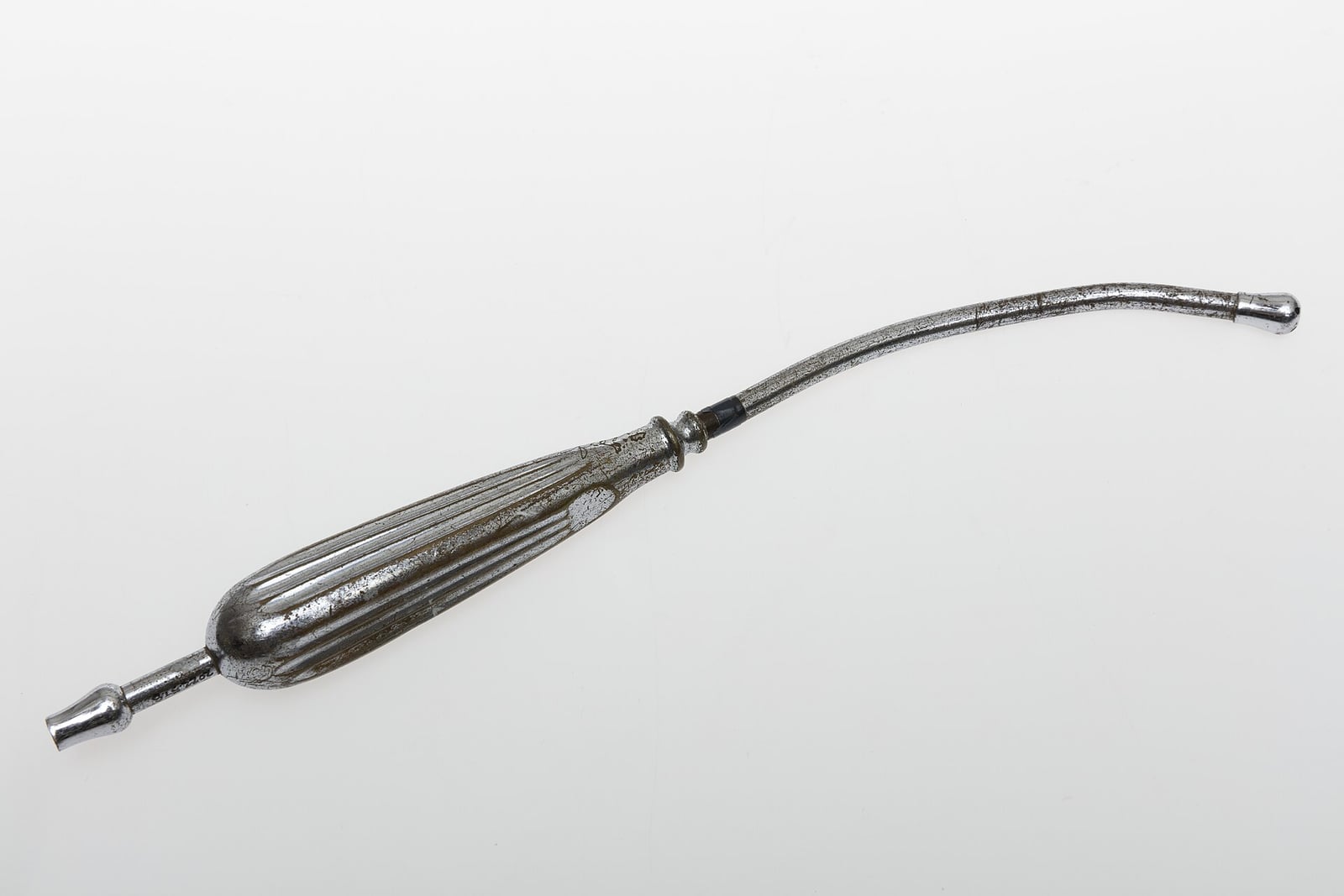
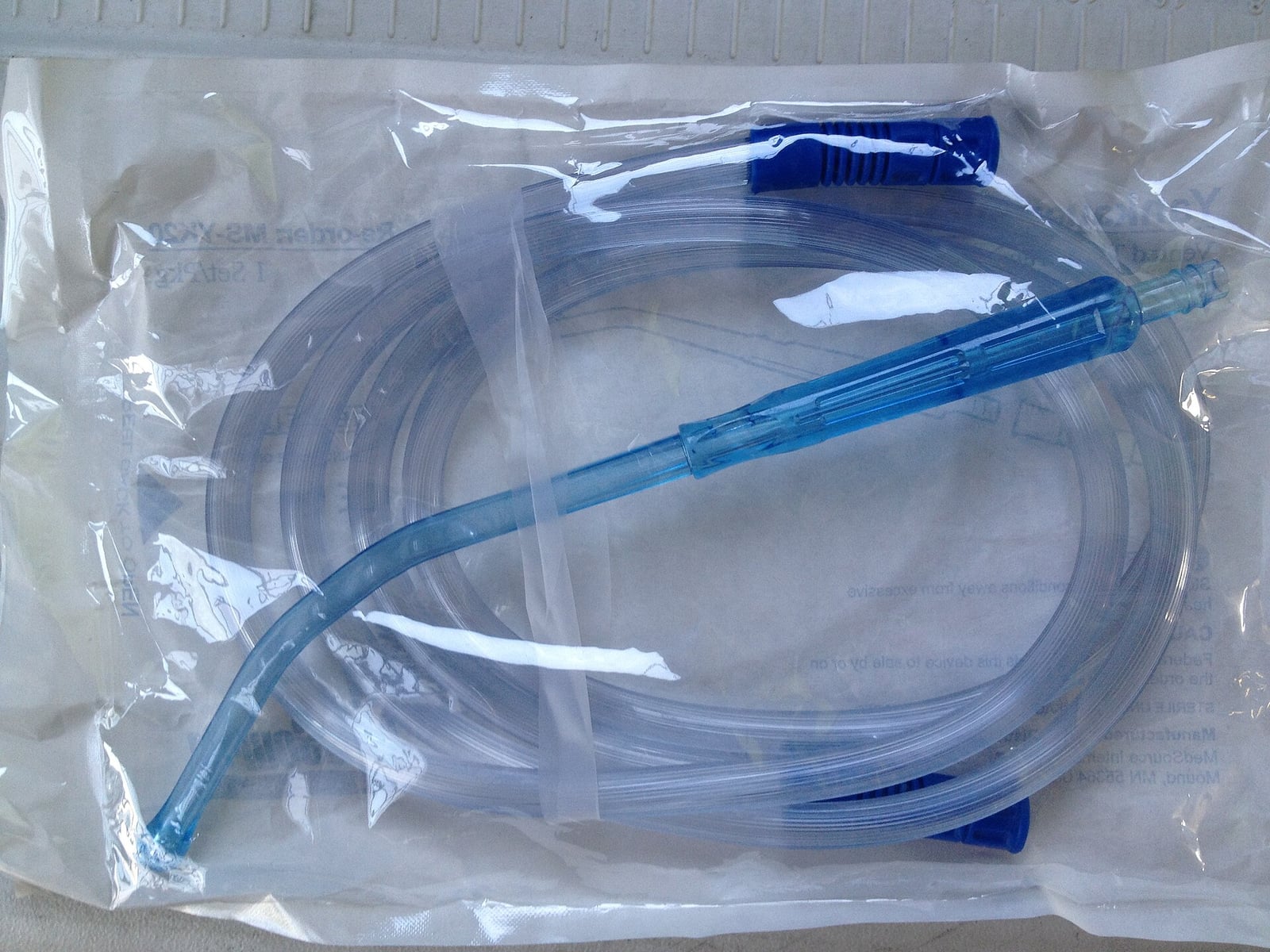
The second is the one that made his name permanent. In 1907 Yankauer designed a rigid suction instrument for clearing the operative field during tonsillectomy: a curved metal tube ending in a bulbous, perforated tip whose rounded form and small side holes let it pull blood and secretions away without grabbing and injuring the soft tissue around it. That is the Yankauer suction tip, and it is still — more than a century later — the most commonly used suction instrument in the world, standard issue in essentially every operating room, emergency department, and ambulance. The original reusable metal design was joined in the late twentieth century by sterile disposable plastic versions, but the geometry is Yankauer’s. The mask is a museum piece; the tip is on a wall bracket in the next trauma bay.
There is one honest complication in this tidy story, and it is worth flagging rather than smoothing over. For an instrument this ubiquitous, no original publication by Yankauer describing the suction tip has ever been located in the literature; the “1907” date and the tonsillectomy origin are the settled account but rest on secondary tradition rather than a traceable founding paper. The name stuck to the object so thoroughly that the paperwork behind it was never needed — and, apparently, never written, or never found. The machine dive treats this uncertainty at length; it is the sort of gap this whole wing was created to be honest about.
3.4 The Sorensen “Tankless” as the exemplar
Of the firms that built combined pressure-and-suction outfits, the C. M. Sorensen Company of New York is the one this collection can document in the most detail, because a specimen sits in my own collection and two independent primary sources pin down what it is. Sorensen was, from its earliest directory listings, in the “Electric Air Compressor” business; its trade name “Tankless” advertised the very feature described above — that the machine made its pressure and vacuum on demand from a running pump, with no stored-air reservoir tank to charge or bleed. Its 1926 catalog (copyright 1925), Sorensen Tankless Apparatus for the Nose and Throat Specialist and the Hospital, is forty-eight pages of ENT, hospital, anesthesia, and surgical-suction equipment, and contains not one mortuary reference.
On its pages is the No. 60, “Dr. S. Yankauer Outfit for Pressure and Suction” — the two-cylinder machine described throughout this volume: eccentric pump, 1/20-hp universal motor, two air purifiers, the square 8-oz ether bottle and round 16-oz suction bottle that “can not be transposed,” on a mahogany base, with an electric switch “incorporated in every machine.” Nine years earlier, a Sorensen advertisement in The American Year-Book of Anesthesia and Analgesia for 1917–1918 had already offered the same machine as a portable anesthesia outfit “especially designed for tonsil and adenoid operations,” able to give ether vapor through one bottle and draw blood and secretion into the other. The design is remarkably stable across that decade, and it is the clearest surviving illustration of the combined-outfit idea in production hardware. The full evidentiary chain — catalog, advertisement, address chronology, and the diagnostic bottle detail — is laid out in the machine’s own dive.
3.5 The myth, corrected once more
Because it recurs at auction and this volume is where a reader arrives asking about it, the correction bears one plain restatement. Machines of this Sorensen type are routinely listed — on auction sites, on price-guide aggregators, and in collector lore — as “C. M. Sorensen embalming machines.” They are not. The label is a self-propagating market error with no documentary basis; it survives because a motor-driven air pump that pressurises a fluid bottle through a dip tube does genuinely resemble a period air-pressure embalming machine (a real device — cf. US Patent 2,252,624, Gilmore & Junod, 1941 — which was not a Sorensen product). The resemblance is architectural; the product is not the same. A 1/20-horsepower pump making 10–15 psi, feeding an eight-ounce ether bottle, cannot do arterial injection, which is measured in gallons at far higher pressure. As early as 2015 a mortician of forty years’ standing rejected the “embalming machine” label on exactly these capacity grounds. What the machine actually is — a Yankauer pressure-and-suction outfit for the nose-and-throat office — is the subject this whole wing is founded on, and the detailed proof is one click away in C. M. Sorensen “Tankless” Pressure and Suction.
Sources
- Sidney Yankauer — LITFL Medical Eponym Library — biography (1872–1932), the ~1904 mask, the 1907 suction tip, the 1905 bronchoscopy, and the note that no original publication for the suction tip has been located.
- Sidney Yankauer — Wikipedia — birth/education, 1917 directorship of Mount Sinai laryngology, the Yankauer mask and its Gwathmey modification.
- Yankauer suction tip — Wikipedia — the 1907 design and its status as the most commonly used suction instrument in the world.
- The History of the Yankauer Suction Tip and Where Med Tech Is Today — SSCOR — modern use in operating rooms and ambulances; the shift to sterile disposable versions.
- Yankauer masks — Wood Library-Museum of Anesthesiology — surviving specimens of the mask the outfit’s ether circuit fed.
- 1926 Catalog of Sorensen Tankless Apparatus for the Nose and Throat Specialist and the Hospital — Internet Archive — the No. 60 “Dr. S. Yankauer Outfit for Pressure and Suction” entry: two-cylinder eccentric pump, 1/20-hp universal motor, two air purifiers, the non-transposable ether and suction bottles.
- The American Year-Book of Anesthesia and Analgesia, 1917–1918 — Internet Archive (Yale copy) — the Sorensen “Yankauer Combination Pressure & Suction Outfit” advertisement.
- US 2,252,624 — “Embalming machine,” Gilmore & Junod, 1941 — Google Patents — a genuine air-pressure embalming machine, cited only for the architectural family resemblance behind the misattribution.
Comments (0)