Surgical & Anesthesia Apparatus · Volume 2
Putting Patients to Sleep
For as long as there had been surgery there had been pain, and for the whole of that time the two were assumed to be inseparable. The apparatus in this volume is the hardware of the moment that assumption broke. In the space of a single generation — roughly 1846 to 1918 — the operating room acquired a new class of object entirely: the inhaler, the mask, the drop bottle and finally the gas machine, the trolley of glass, brass and rubber that stood at the head of the table and did nothing surgical at all. This is the history of those objects and of the volatile chemistry they were built to handle. It is deliberately a history of apparatus, not of practice: what the inhaler was, how the mask worked, who made the machine and why its shape changed. It is not, anywhere, an account of how to render a person unconscious.
2.1 Before the Ether Dome: laughing gas and the showmen
The chemistry arrived decades before the surgery. In 1799 the young English chemist Humphry Davy, working at Thomas Beddoes’s Pneumatic Institution in Bristol, began inhaling nitrous oxide and in 1800 published a book describing its effects, including the striking observation that it seemed to abolish physical pain and might therefore be useful during surgical operations. Nobody acted on the suggestion for nearly half a century. Instead nitrous oxide and ether became entertainment — “laughing gas” demonstrations and “ether frolics” that travelled the lecture circuit as popular science theatre.
It was at exactly such a demonstration that the practical idea surfaced. In December 1844 the Hartford dentist Horace Wells attended a nitrous oxide exhibition staged by the showman Gardner Colton and watched a volunteer gash his leg without apparently feeling it. The next morning, 11 December 1844, Wells had one of his own teeth extracted while inhaling the gas from a bag and reported feeling nothing. Wells had grasped the principle, but his public demonstration at Massachusetts General Hospital in early 1845 went badly — the patient cried out — and the medical audience dismissed him. The lesson the apparatus makers eventually drew from Wells’s failure was that the chemistry was necessary but not sufficient: what was missing was reliable delivery.
2.2 Ether Day, 16 October 1846
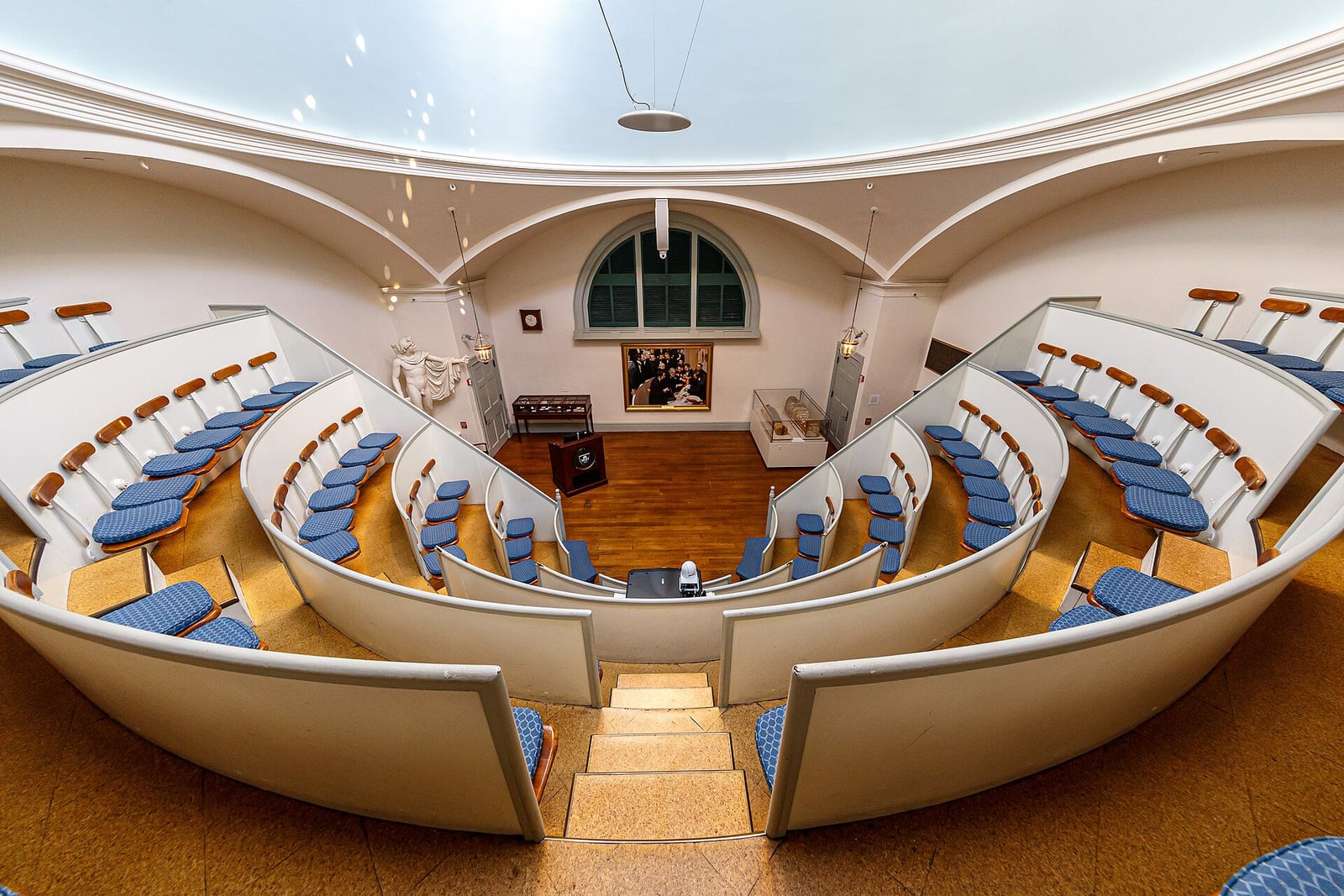
The demonstration that stuck was made not with nitrous oxide but with sulfuric ether, and it turned on a piece of equipment. On 16 October 1846, in the surgical amphitheatre at Massachusetts General Hospital that would forever after be called the Ether Dome, the Boston dentist William T. G. Morton administered ether to a young patient, Edward Gilbert Abbott, while the senior surgeon John Collins Warren removed a vascular tumor from Abbott’s jaw and neck. Abbott was reported to have felt no pain, and Warren turned to the gallery with the line that entered the textbooks: “Gentlemen, this is no humbug.”
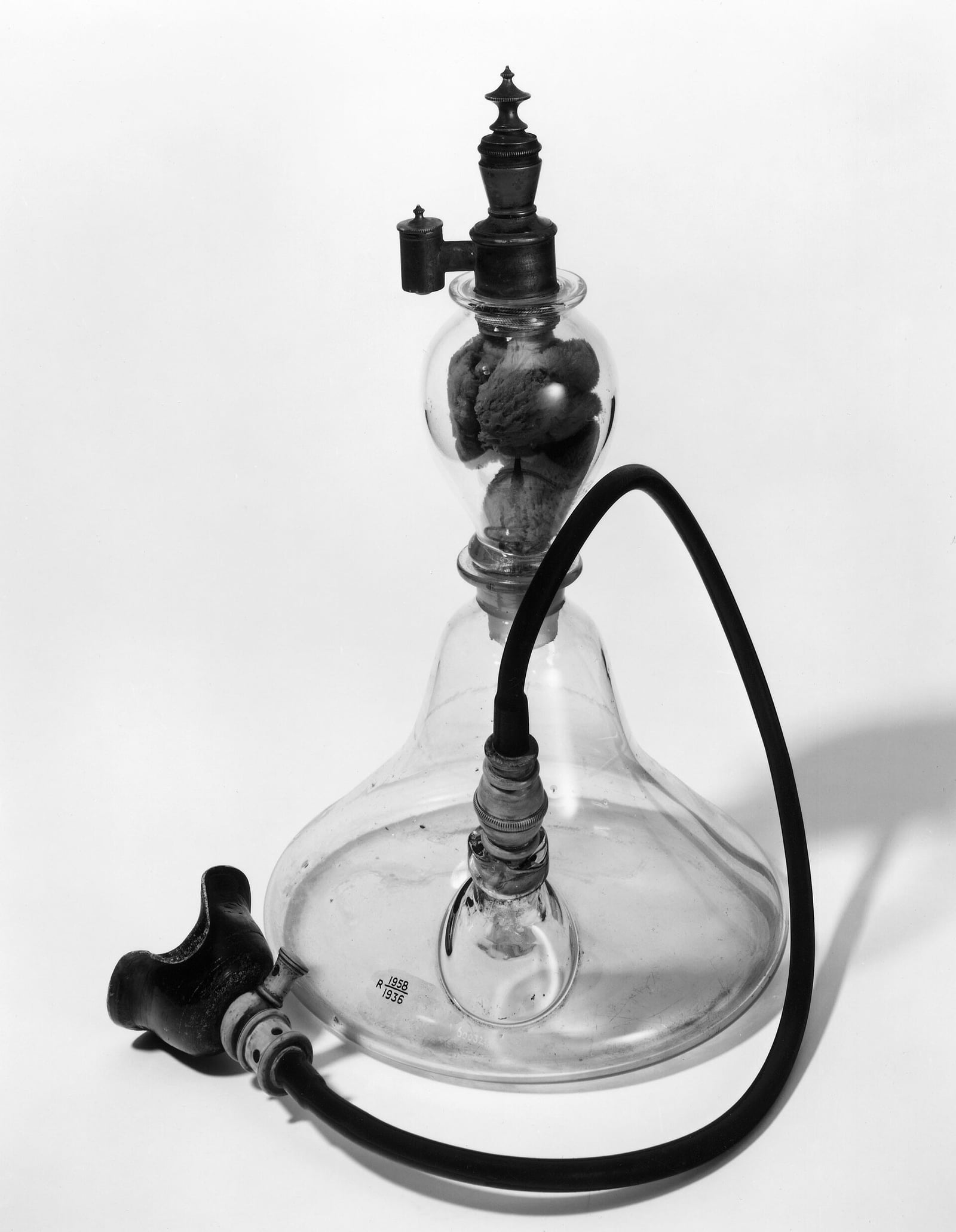
Morton’s contribution was as much an object as an idea. Rather than a soaked sponge held to the face, he used a purpose-made glass inhaler — a globe containing an ether-soaked sponge, with a mouthpiece and valves arranged so that inhaled air passed through the vapor-laden chamber. It was crude, and Morton spent years afterward in an unedifying priority dispute with the physician Charles Jackson and with Wells, but the device made the effect repeatable in front of witnesses, which is precisely what Wells’s bag had not done. Between 1821 and 1868 more than eight thousand operations were performed in that one amphitheatre; the news of Ether Day crossed the Atlantic within weeks, and by the end of 1846 surgeons in London and Paris were etherizing patients.
2.3 Chloroform, and the first argument about safety
Ether had drawbacks as a substance to handle — it was slow to take effect, pungent, and dangerously flammable in a room lit by open flames. In Edinburgh the professor of midwifery James Young Simpson went looking for something better. In late 1847 Simpson and two assistants worked through a series of volatile liquids by the direct and reckless method of inhaling samples themselves at his dining table; when they tried chloroform they collapsed insensible, and Simpson concluded he had found his substitute. He first used it in obstetrics on 8 November 1847, and within days it was in surgical use. Chloroform was more potent, faster and non-flammable, and it spread rapidly — helped enormously in 1853 when John Snow administered it to Queen Victoria during the birth of Prince Leopold, which lent the practice royal respectability.
But chloroform carried a hazard ether did not. On 28 January 1848, a healthy fifteen-year-old named Hannah Greener died in Winlaton, near Newcastle, while being given chloroform for the removal of a toenail — the first death attributed to an anesthetic. She had tolerated ether for the same procedure months earlier. Her death opened the safety debate that would run for the rest of the century. Chloroform, it emerged, could stop the heart abruptly, sometimes early and without warning, whereas ether’s dangers were slower and more visible. The argument split along national and institutional lines and produced one of the first great exercises in medical fact-finding: the Hyderabad Chloroform Commissions of 1888 and 1889, funded by the Nizam of Hyderabad and scrutinized for The Lancet by the pharmacologist Thomas Lauder Brunton, which experimented at length on animals to determine how chloroform killed. The commissions reached the reassuring but mistaken conclusion that chloroform stopped breathing before it stopped the heart; the truth — that it could do the reverse — was worked out only later. For the collector, the significance is that the ether-versus-chloroform controversy shaped the apparatus: it is why so much later equipment was built to meter and dilute the vapor rather than simply present it.
2.4 John Snow and the idea of a regulated inhaler
The man who first treated administration as an engineering problem was John Snow, better remembered today for tracing a London cholera outbreak to the Broad Street pump. Snow was dissatisfied with the open method of pouring liquid onto a handkerchief or sponge, which gave no control over how much vapor a patient actually received. In 1847 he produced an ether inhaler and published his early results, and in 1848 he built a chloroform inhaler that combined a molded face-piece, an adjustable air valve and a metal vaporizing chamber sitting in a water bath — the water bath compensating for the way evaporation chills a liquid and weakens its vapor. Snow also described a sequence of stages of etherization, generally regarded as the first formal framework for reasoning about anesthetic depth. His inhalers were the ancestors of every later attempt to make delivery a matter of calibrated hardware rather than an operator’s feel.
2.5 The drop bottle and the wire mask
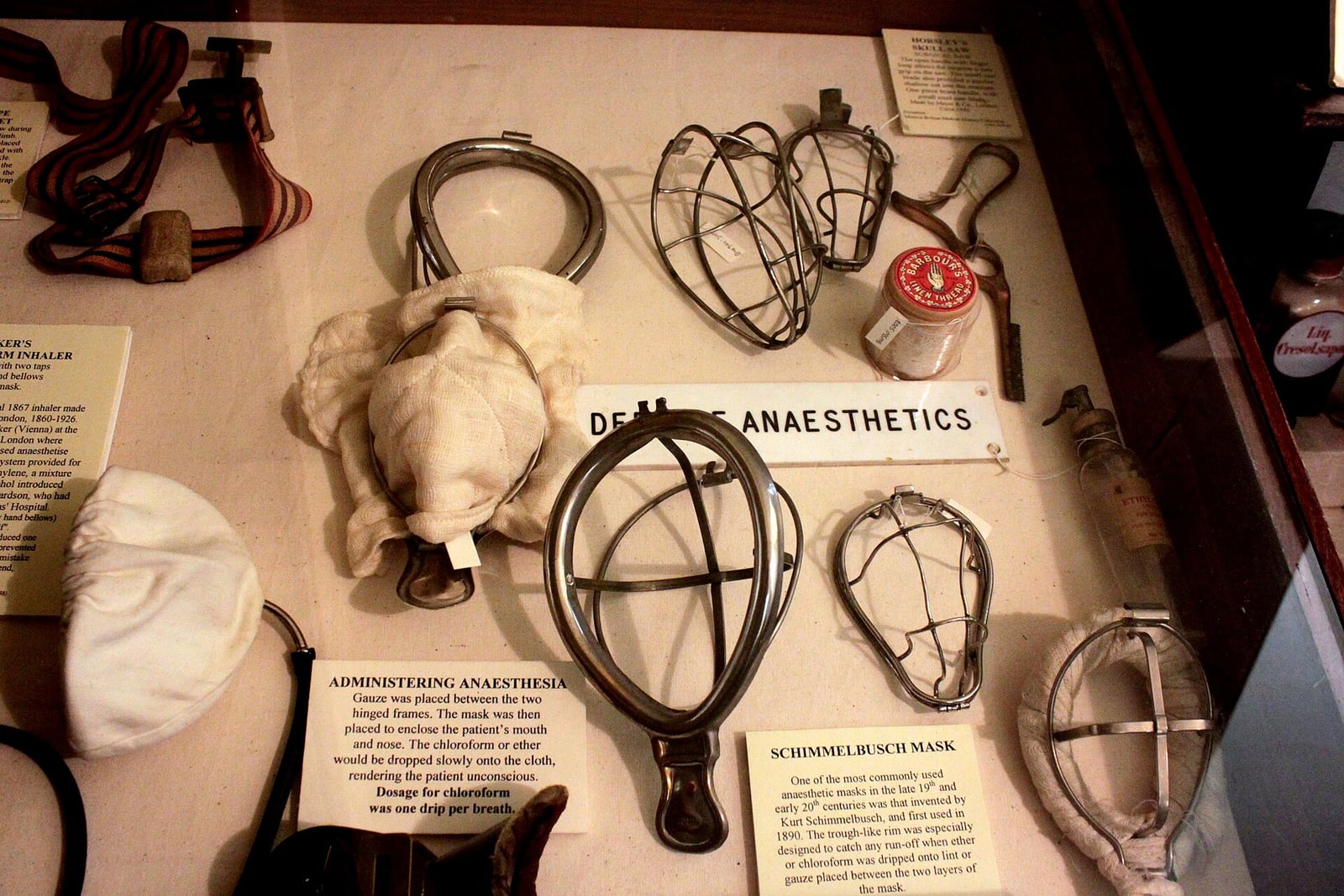
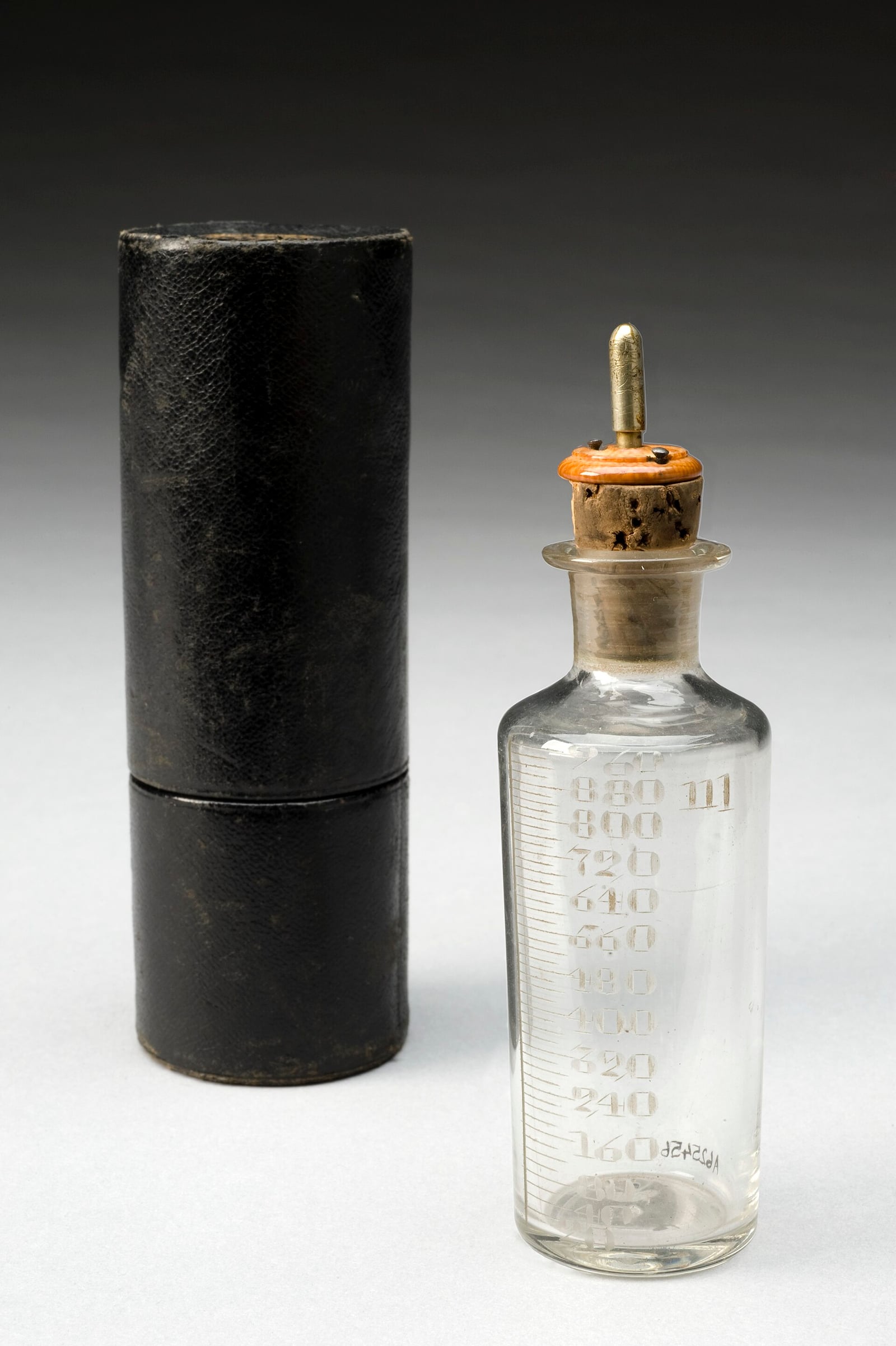
For all Snow’s ingenuity, the dominant apparatus for the next half-century was almost aggressively simple: the open mask and the drop bottle. The mask was a light wire frame shaped to fit over the nose and mouth and covered with several layers of gauze; volatile liquid was let onto the gauze drop by drop from a bottle, and the patient breathed a mixture of air and evaporated vapor. The bottles themselves became a small genre of object — graduated glass or metal drop bottles, some with spring caps or perforated tops designed to release the liquid in controlled drops rather than a splash.
The best-known frame is the Schimmelbusch mask, designed in 1889 by the German surgeon Curt Schimmelbusch (1860–1895), whose name also attaches to the aseptic sterilizing drum; he filed for a US patent from Berlin that October and was granted it in June 1890. Schimmelbusch’s insight was as much about asepsis as about anesthesia: because both ether and chloroform blister skin on prolonged contact, he built a metal mask over which gauze could be stretched and clamped by a hinged rim, keeping the wet cloth off the face and allowing the whole frame to be sterilized between uses. It was cheap, foolproof and endlessly copied, and it remained in service well into the twentieth century — which is why it is one of the commonest pieces of antique anesthesia apparatus to survive. In American ear-nose-and-throat and dental work the analogous object was the wire ether mask associated with Sidney Yankauer, the New York laryngologist whose suction tip is the subject of this wing’s founding dive; the Yankauer ether mask is a folding wire cage of the same family. The apparatus in my own collection sits directly on this history: the C. M. Sorensen “Tankless” outfit was built to carry ether vapor from a bottle to exactly such a face mask, using air pressure from its little pump — a pressure-and-suction link to the anesthesia story explored in the Sorensen dive.
2.6 From bottle to machine: the continuous-flow apparatus
The open mask left everything to the operator’s judgement, and it could deliver only one agent at a time, at a concentration that drifted with temperature and technique. The next leap in apparatus was the continuous-flow anesthesia machine, which brought compressed gases, measured flows and vaporized liquid together into a single delivery stream. Its enabling change was industrial: by the early twentieth century nitrous oxide and oxygen could be bought compressed in steel cylinders, so a machine could be fed from a reliable supply rather than a bag or a bladder.
The American anesthetist James Tayloe Gwathmey, working with the physician William Woolsey, built an early continuous-flow apparatus around 1912 that passed nitrous oxide, oxygen and ether together toward the patient. The design that became the template, however, was assembled in London. In 1917 the anesthetist Henry Edmund Gaskin Boyle adapted Gwathmey’s arrangement into what became known simply as Boyle’s machine, presenting it at the Royal Society of Medicine in 1918. In Boyle’s apparatus the compressed gases were led from their cylinders, their flow rates read off measuring devices, and then bubbled through glass bottles — one for water-saturation, one containing liquid ether — so that the gas stream picked up a controlled charge of vapor before reaching a face-piece. All the essential ideas of the modern machine are already present: a continuous, measured supply of gases, an accurate concentration of anesthetic vapor, and delivery at a safe pressure. The design was so sound that it stayed in production for roughly fifty years, outliving the absorption of the original maker Coxeter into the British Oxygen Company in 1939 — which is why “Boyle’s machine” and “BOC Boyle” are both terms a collector encounters.
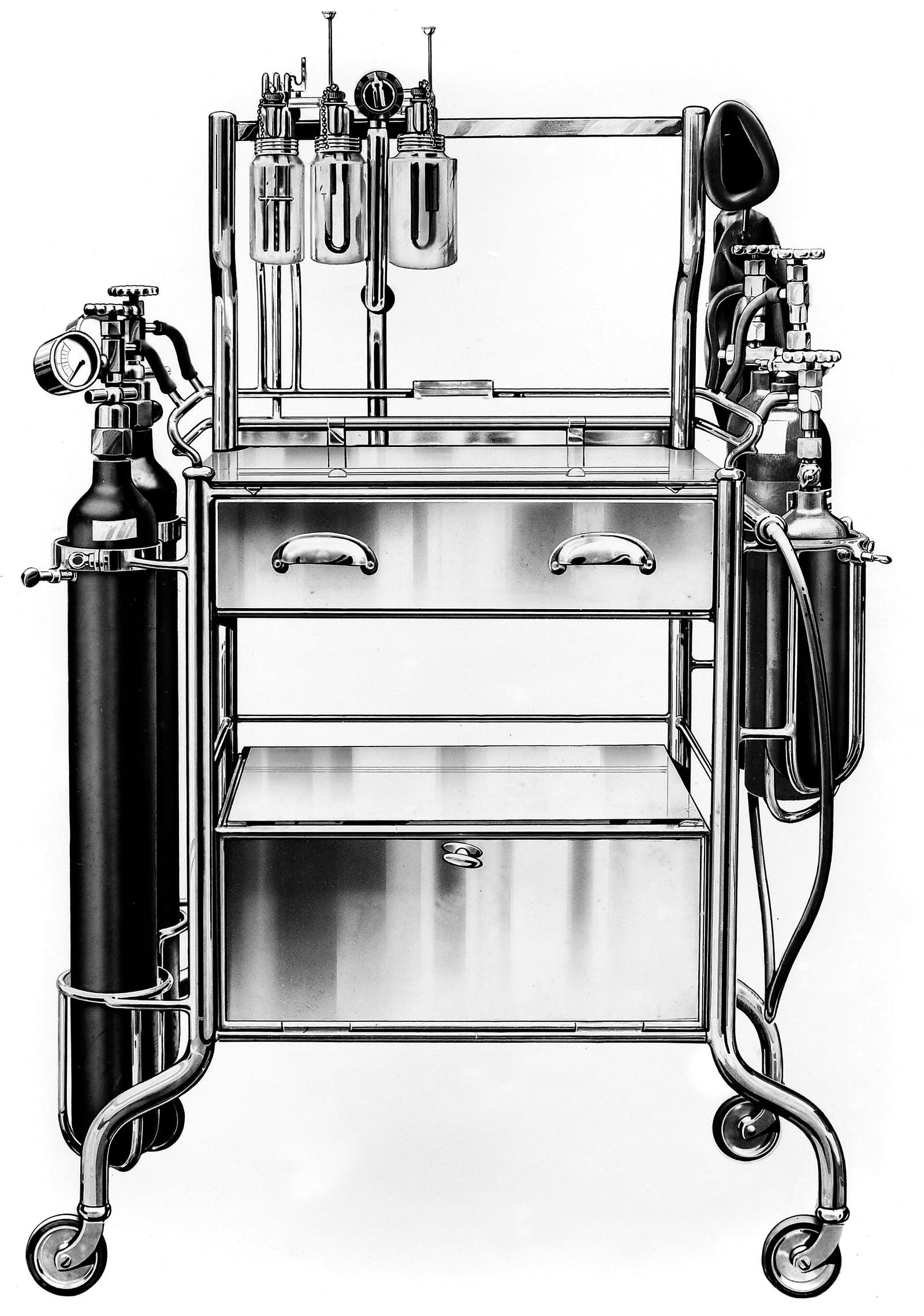
2.7 What the objects tell us
Laid out in sequence, the apparatus records a single trajectory. It runs from the sponge in a glass globe, through the wire-and-gauze mask that any office could afford, to the wheeled machine of cylinders and flow bottles that made anesthesia a metered, engineered supply rather than a liquid dripped onto cloth. Each object embodies a lesson the previous one taught: Morton’s inhaler that delivery must be repeatable; Snow’s water-bath vaporizer that concentration must be controlled; Schimmelbusch’s frame that the equipment must be cleanable; Boyle’s machine that gases and vapor must be measured, not guessed. The chemistry — Davy’s nitrous oxide, Morton’s ether, Simpson’s chloroform — barely changed across the period; what changed, and what survives on collectors’ shelves and in museum cases, is the hardware built to tame it. As objects they are the physical record of the moment surgery stopped being a race against a conscious patient, and that is reason enough to study the shape of an old brass inhaler closely.
Sources
- The Ether Dome at Mass General
- Ether & Ether Dome History — MGH Guides
- 175th Anniversary of the First Public Demonstration of Ether
- Edward Gilbert Abbott — Wikipedia
- Ether Dome — Wikipedia
- James Young Simpson’s Discovery of Anaesthetic Uses of Chloroform, 1847 — University of Edinburgh
- Sir James Young Simpson — Royal College of Physicians of Edinburgh
- John Snow — LITFL Medical Eponym Library
- Snow Inhaler, Mark II — Wood Library-Museum of Anesthesiology
- John Snow, the First English Anaesthetist, Part 4: 1847, Ether and Chloroform — Old Operating Theatre Museum
- Horace Wells Discovers Pain-free Dentistry — Connecticut History
- Horace Wells — Britannica
- Nitrous Oxide — NCBI Bookshelf
- Schimmelbusch mask — Wikipedia
- Schimmelbusch Mask — Wood Library-Museum of Anesthesiology
- Schimmelbusch mask for open chloroform anaesthesia — Science Museum Group
- An Unexplained Death: Hannah Greener and Chloroform — Semantic Scholar
- Hyderabad Chloroform Commission — Wikipedia
- Boyle-type anaesthetic apparatus, London, 1918 — Science Museum Group
- Boyle Apparatus — Wood Library-Museum of Anesthesiology
- Anaesthesia Machine — History and Evolution
Comments (0)