Surgical & Anesthesia Apparatus · Volume 1
The Operating Room Takes Shape
1.1 The room before the apparatus
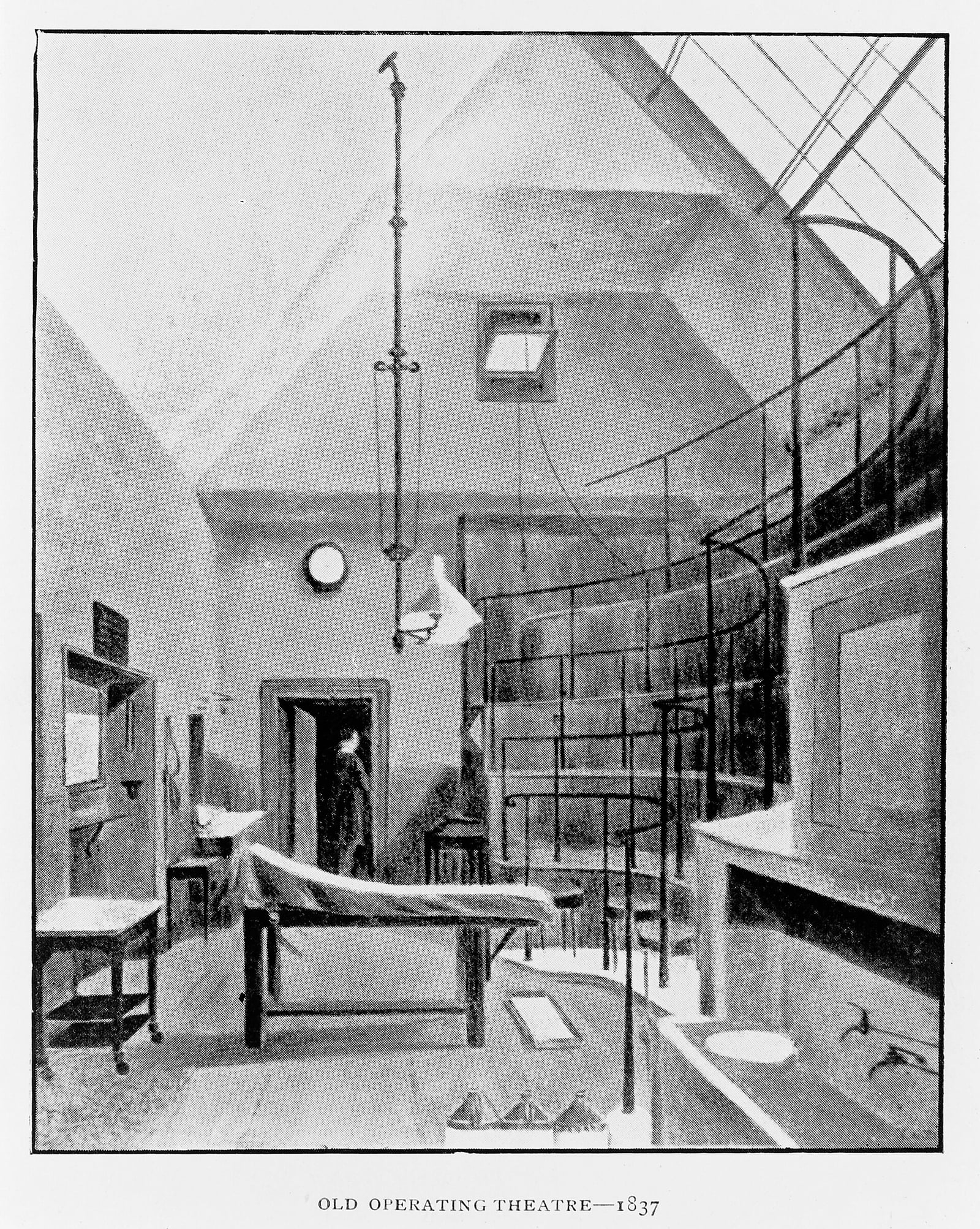
The modern operating room is a machine — a purpose-built assembly of steel, glass, enamel, plumbing and electricity, every surface chosen to be scrubbed and nothing in it accidental. That is a surprisingly recent invention. As late as the 1860s the “operating theatre” was closer to its literal name: a raked amphitheatre of wooden benches, a plain deal table stained by long use, sawdust on the floor to catch what fell, and surgeons who operated in street clothes or in a stiff frock coat kept precisely because it was caked with the residue of earlier work. Instruments had ivory or wooden handles and were wiped, not sterilized. A tour of such a room today would be recognizable as theatre and unrecognizable as surgery.
What transformed it was not a single machine but an idea — that wounds were poisoned by something invisible — and the apparatus that idea demanded. Between roughly 1867 and 1920 the operating room acquired the equipment we still recognize: the sterilizer, the enamelled table, the instrument cabinet, the glass-topped trolley, the drum of sterile dressings, the gowned and gloved and masked team. This volume is the engineering and trade history of that room — how it acquired its kit and who built it.
1.2 Lister and the carbolic idea
The pivot is conventionally dated to 1867 and to one surgeon: Joseph Lister (1827–1912), working in Glasgow. Reading Louis Pasteur’s work on fermentation and putrefaction, Lister reasoned that the “hospital diseases” that killed so many surgical patients — the gangrene and sepsis that made even a successful operation a gamble — were caused by living microorganisms carried to the wound, not by some property of the air itself (“miasma”). If the culprit was living, it could be killed.
Lister had begun experimenting with carbolic acid (phenol) around 1865, having heard it used to deodorize sewage in Carlisle. He soaked dressings and ligatures in it, dosed the wound directly, and treated his hands and instruments. In 1867 he published the results in The Lancet as “On a New Method of Treating Compound Fracture, Abscess, etc.” — beginning with the case of an eleven-year-old, James Greenlees, whose compound fracture healed without the amputation such an injury would ordinarily have forced. It was antisepsis: not a clean room, but a chemical war waged against germs at the wound.
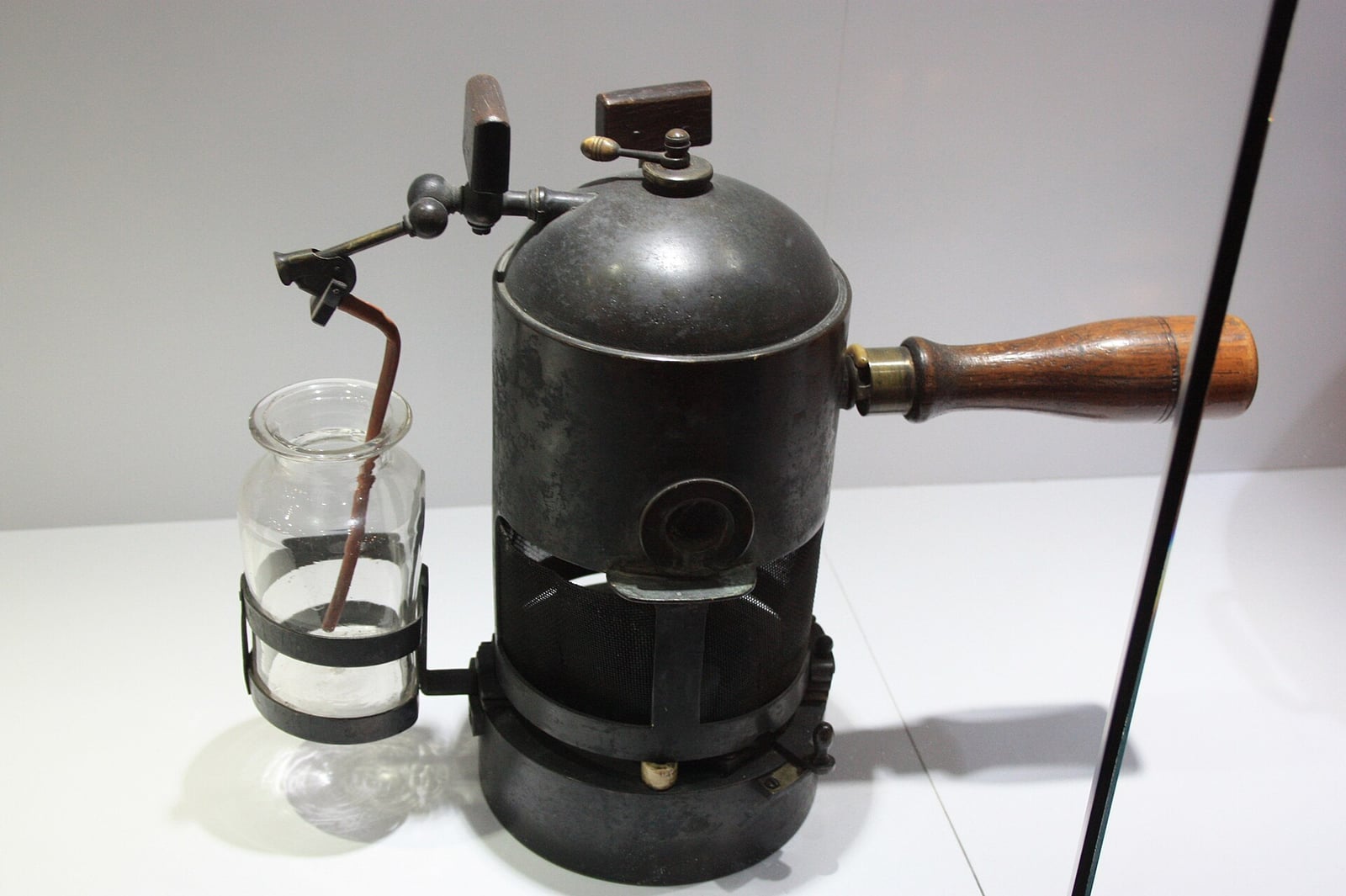
The most famous piece of apparatus from this period — the carbolic spray — is also the one that did not last. Between roughly 1871 and 1887 Lister used a pump-driven spray, hand- or steam-powered, to fill the operating field with a fine mist of dilute carbolic, on the theory that airborne germs had to be killed too. It was miserable to use: it chapped and cracked the surgeons’ hands, irritated eyes and lungs, and drenched everyone in the room. Worse, it was aimed at the wrong target. Lister himself eventually abandoned it, reportedly with the remark that he was ashamed he had ever used it — because the danger was not floating in the air but riding in on hands, instruments and dressings. The spray is the perfect museum object: iconic, evocative, and a dead end. It marks the moment surgery took infection seriously, and the moment it learned it had misjudged the route.
1.3 From antisepsis to asepsis
The deeper revolution was the shift from antisepsis — killing germs with chemicals at the point of contact — to asepsis: excluding germs from the field altogether by making everything that touched the wound sterile beforehand. Antisepsis fought a battle at the wound; asepsis moved the battle back to the preparation table, the sterilizer and the door.
That shift was worked out chiefly in Germany in the 1880s, and its central figure is Ernst von Bergmann (1836–1907) of Berlin, with his assistant Curt Schimmelbusch (1860–1895). Bergmann introduced steam sterilization of instruments and dressings — commonly dated to 1886 — and by 1891 had built a whole surgical practice around aseptic principles. Bergmann and Schimmelbusch presented the aseptic method to the world at the Tenth International Medical Congress in Berlin in 1890, and Schimmelbusch’s Guide to the Aseptic Treatment of Wounds codified it. The logic was different from Lister’s: instead of pouring antiseptic into an operation, you sterilized every instrument, dressing and cloth in advance, kept them sterile, and touched the wound only with what had passed through the sterilizer.
Asepsis is why the operating room looks the way it does. A room built to stay sterile cannot have upholstery, carved wood, drapery or crevices. It wants hard, non-porous, washable surfaces everywhere — hence the sudden dominance, from the 1890s onward, of white enamelled iron, plate glass, and nickel-plated steel. The furniture had to be designed, and that created a trade.
1.4 The sterilizer arrives
The single most important new machine in the aseptic operating room was the sterilizer. Two lines of descent converged in it.
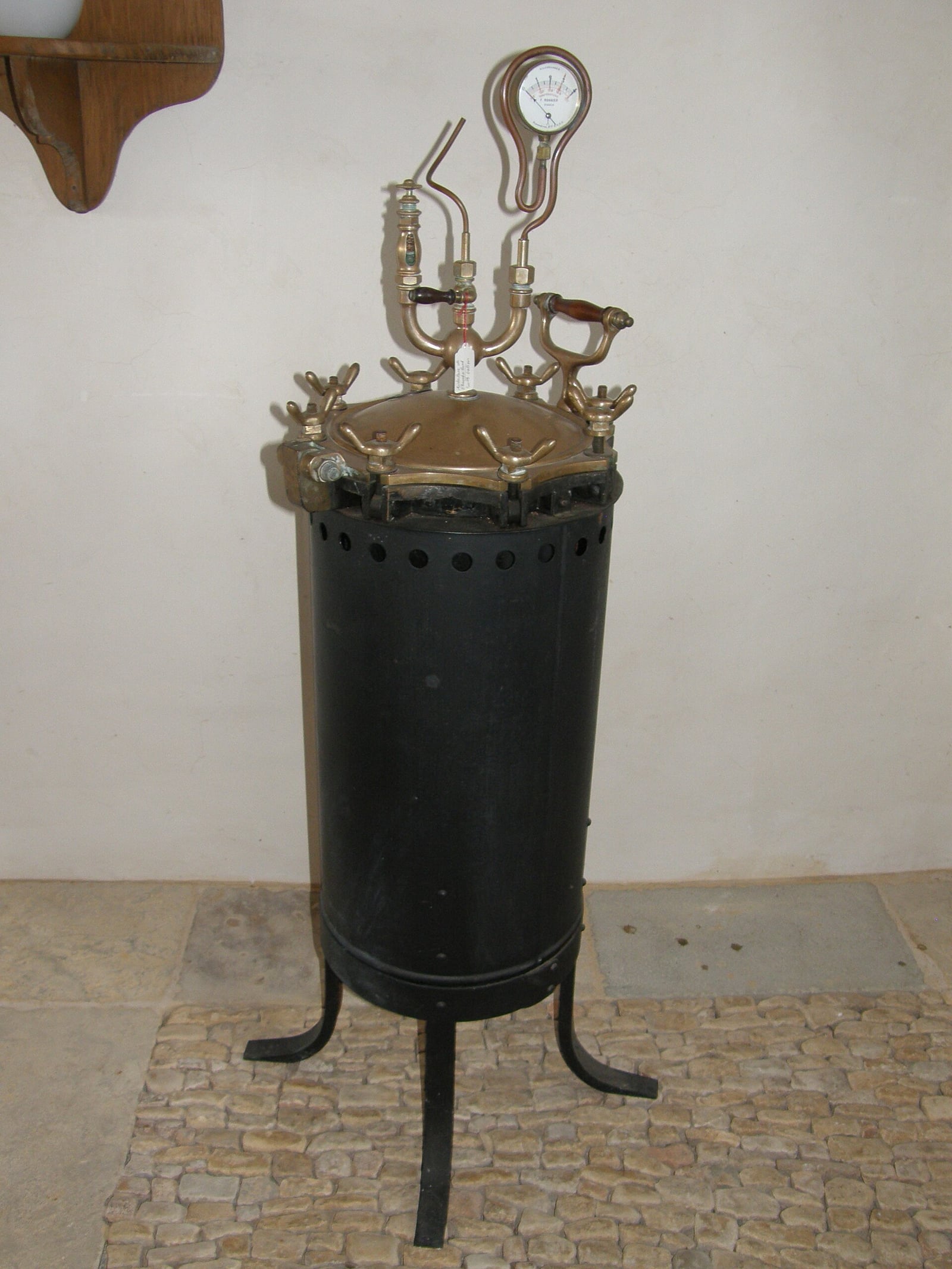
The first was the autoclave — a sealed vessel that raises steam under pressure so it reaches temperatures far above the boiling point of water, hot enough to kill not just bacteria but their heat-resistant spores. Its direct ancestor is Denis Papin’s “steam digester” of 1679, a pressure-cooker for softening bones. The medical instrument, however, comes from Pasteur’s laboratory: Charles Chamberland (1851–1908) built a pressurized steam sterilizer in 1879, having established that killing resistant spores required holding the load at roughly 115–120 °C — a temperature only pressurized steam could reach. The word autoclave — from Greek auto- (self) and Latin clavis (key), “self-locking,” because internal pressure seals the lid — belongs to this machine. What began as bench apparatus for growing cultures of cholera and anthrax became, within a decade, the sterilizer at the heart of the operating suite.
The second line was dry and flowing-steam sterilization of the bulkier things — dressings, gauze, gowns, drapes — which do not fit an instrument tray. Here Schimmelbusch’s contribution was intensely practical: the Schimmelbusch drum, a cylindrical metal canister with a band of holes around its circumference that could be slid open to admit steam during sterilization and shut afterward to keep the contents sterile in storage and transport. Dressings went into the drum, the drum went into the steam sterilizer, and the drum came out as a sealed, sterile package that was opened only at the moment of use. It is one of the most enduring designs in surgery; the drum is still in use, and still called by his name.
Schimmelbusch’s other lasting object belongs half to this volume and half to the next: the Schimmelbusch mask of 1889 — he filed for a US patent from Berlin that October, and it was granted in June 1890 — a kidney-shaped wire frame that held gauze over the patient’s nose and mouth so that ether or chloroform could be dripped onto it. He designed it, characteristically, so that the frame and its gauze could be sterilized — asepsis reaching even the anesthetist’s apparatus. The mask’s role in the delivery of anesthesia is the subject of the next volume; here it stands as evidence of how completely the aseptic idea reorganized every object in the room.
1.5 Gloves, gowns and masks
Asepsis also re-dressed the surgeon. If germs rode in on hands, then the hands had to be dealt with — and skin cannot be autoclaved. The famous answer came from William Stewart Halsted (1852–1922) at the new Johns Hopkins Hospital. In the winter of 1889–1890 his chief surgical nurse, Caroline Hampton — whom he later married — developed a painful dermatitis from the mercuric-chloride antiseptic in which the staff dipped their hands. Halsted asked the Goodyear Rubber Company to make two pairs of thin rubber gloves with gauntlets as an experiment.
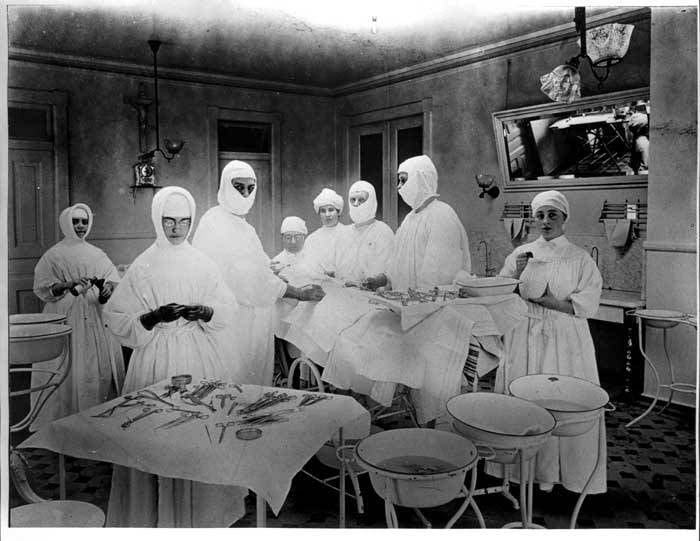
The detail worth keeping is that the gloves were introduced to protect the nurse, not the patient — a comfort measure, not an infection-control one. Only afterward did Halsted’s staff, and notably his associate Joseph Bloodgood, recognize that sterile rubber gloves sharply reduced wound infection. A device invented for one reason survived for a better one. Rubber gloves, sterilizable gowns, and — somewhat later and more slowly adopted — the surgical face mask completed the aseptic envelope: by the 1900s the operating team was gowned, gloved and increasingly masked, a costume that is now the universal shorthand for surgery itself.
1.6 The room as a manufactured product
Every element of this new practice was something that had to be made and sold, and here the story becomes trade history. The demand for hard, washable, sterilizable surfaces created, almost overnight, a market for aseptic operating-room furniture: enamelled-iron and glass-shelved instrument cabinets, glass-topped nickel-plated dressing trolleys, plate-glass instrument tables, enamelled basin stands, and the tilting, jointed operating table in white enamel and nickel that replaced the wooden bench. The instrument itself changed too — the ivory-handled scalpel and the ebony-gripped saw gave way to all-metal instruments that could go whole into the sterilizer without a porous handle to harbor infection. The look we think of as “old-fashioned surgical” — nickel, glass and white enamel — is in fact the modern, post-1890 look, and it exists because of the sterilizer.
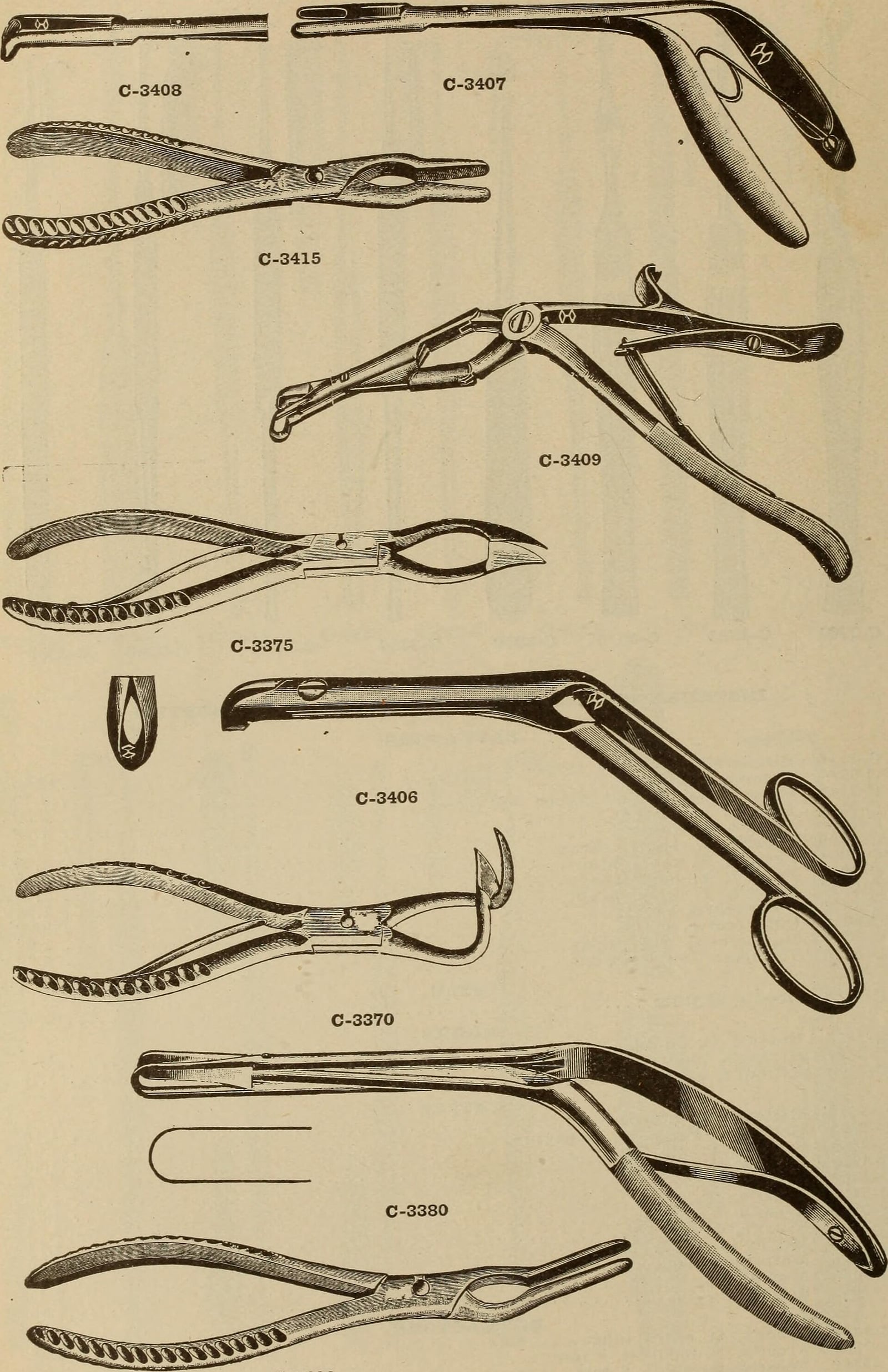
The firms that supplied it were the great surgical-instrument houses, and their catalogs are the best record of the room. In Britain, Down Brothers of London published a comprehensive catalog in 1906 that covered not only instruments but “aseptic hospital furniture,” much of it their own original design; Weiss and later Allen & Hanburys were peers. In the United States, Codman & Shurtleff of Boston (13 Tremont Street) and the Kny-Scheerer Company of New York — whose 1915 volume Illustrations of Surgical Instruments of Superior Quality runs to hundreds of plates — equipped American operating rooms, alongside firms such as V. Mueller of Chicago and J. Sklar. These catalog houses are the connective tissue of the whole wing: they sold the sterilizer, the table, the cabinet, the instruments, and the office outfits of the specialist — the nose-and-throat man’s pressure-and-suction apparatus among them. The same trade that furnished the aseptic theatre furnished the consulting room, which is exactly where this collection’s founding machine comes from: the C. M. Sorensen “Tankless” outfit sold through precisely this catalog world. (See the C. M. Sorensen pressure-and-suction apparatus, where the surgical-supply trade and the specialist’s office meet.)
1.7 What the room became
By about 1920 the transformation was complete. In roughly fifty years the operating theatre had gone from a wooden amphitheatre with a bloodstained coat to a tiled, enamelled, glass-and-nickel room organized entirely around the sterilizer, staffed by a gowned, gloved and masked team, and stocked from illustrated trade catalogs by a mature international instrument industry. The apparatus we recognize — autoclave, dressing drum, instrument cabinet, aseptic table — all dates from this window, and nearly all of it descends from one idea Lister published in 1867 and one refinement Bergmann and Schimmelbusch worked out in the 1880s. Everything that follows in this wing — the anesthesia machines, the pressure-and-suction outfits, the sterilizers and the makers who sold them — is furniture in the room this volume built.
Sources
- Joseph Lister’s antisepsis system — Science Museum
- Lister’s Carbolic Spray — Science Museum Group
- Joseph Lister and the story of antiseptic surgery — Hektoen International
- Joseph Lister (1827–1912): A Pioneer of Antiseptic Surgery — PMC
- Ernst von Bergmann, the surgeon who heat-sterilized surgical instruments — Hektoen International
- Curt Schimmelbusch — Wikipedia
- Ernst von Bergmann — Encyclopædia Britannica
- Charles Chamberland, the inventor of sterilization tools — Institut Pasteur
- Autoclave — Wikipedia
- Autoclave — National Museum of American History
- Caroline Hampton Halsted: the first to use rubber gloves in the operating room — PubMed
- The Nurse Who Introduced Gloves to the Operating Room — Science History Institute
- William Stewart Halsted — LITFL Medical Eponym Library
- Illustrations of Surgical Instruments… Kny-Scheerer Company (1915) — Internet Archive
- Makers of antique American surgical instruments — MedicalAntiques.com
- The surgical instrument maker: an historical perspective — PubMed
Comments (0)